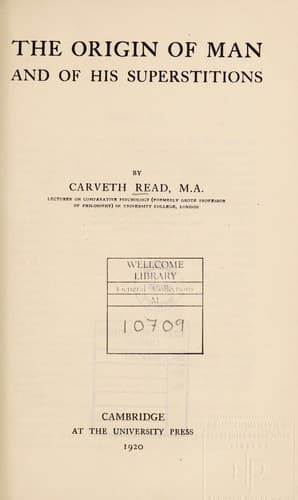
The Origin of Man and of His SuperstitionsRead, Carveth
Philosophy
The Origin of Man and of His Superstitions
Read, Carveth
Animism; Human beings -- Origin; Magic; Superstition; Totemism
The journey of ghosts to their own world may be short or long, an
unadorned migration or rich in details of adventure. They may begin
the new life exactly as they finished this one, or the old may be
rejuvenated. As to their manner of life there, oftenest it is a
repetition of their earthly state, perhaps better, or even much
better, perhaps worse. And this conception is historically of the
utmost importance: for (1) it seems to give the greatest confidence
in a hereafter. Hume ascribes what seemed to him the incredulity of
men with regard to a future life “to the faint idea we form of our
future condition, derived from its want of resemblance to the present
life.”[245] And (2) from this conception proceeds the development of
ghostly polities: presided over, according to tribes that have no
chiefs, by a headman, such as Damarulum, or by the greatest known
hunt-leader, like Kande Yaka of the Veddas; under advancing political
structures, by chieftains, amongst whom one may be paramount, and
so become a king or lord of all. These ghostly politics support the
earthly ones they imitate. It is everywhere an edifice built by hope
and fear, under the guidance of analogy, and sometimes decorated by
caprice, if this find acceptance with the tribe.
§ 9. THE TREATMENT OF GHOSTS
The behaviour of men toward the ghosts of their dead is chiefly
governed by fear. The human power that has left the corpse is now
invisible; that power, rarely quite trustworthy whilst in the body,
especially when unobserved, retains its desires, caprices and hatreds
that were partially controlled by social influences. What controls
them now that the man is exempt from observation? How shall one defend
oneself against him, or procure his neutrality, or even (as sometimes
in the flesh) his help? The fear of ghosts has peculiar qualities:
the invisibility of a spiritual enemy produces a general objectless
suspicion and a sense of helplessness; associations with the physical
conditions of the corpse and with darkness excite feelings very much
like those aroused by snakes and reptiles. This fear explains why
savages, such as the Australians, may believe in ghosts for ages
without ever venturing to pray even to father or mother deceased; for
to pray is to invoke, and they will come, and, on the whole, they are
not wanted. Fear may make the survivors quit the neighbourhood of the
dead; sometimes makes them adopt means to induce the ghost to leave,
and invent stories of how and whither he goes, which are believed by
biological necessity; because, unless they can be rid of the ghost and
the dread of him, or establish in some way the _pax deorum_, it is
impossible to go on living.
Public-domain text, read in full here on John Shaqi.
Reviews
Reviews
No reviews yet
Be the first to share your thoughts on this work.
Elsewhere in the archive
Join the Discussion
Join the discussion
Sign in to leave a comment or review.
Sign InorCreate an account