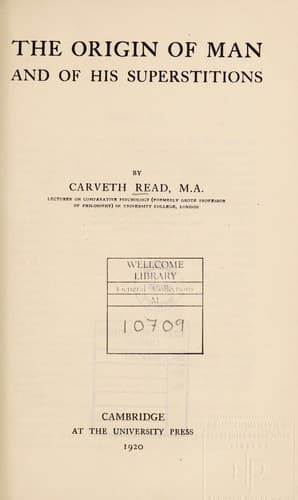
The Origin of Man and of His SuperstitionsRead, Carveth
Philosophy
The Origin of Man and of His Superstitions
Read, Carveth
Animism; Human beings -- Origin; Magic; Superstition; Totemism
The Yerkla-mining never bury their dead, nor in any way dispose of
them. On seeing death approaching a tribesman, they make up a good fire
for him, and leave the neighbourhood, not to return for a considerable
time.[246] The Sakai, having buried the dead affectionately with
necklaces, wallets, etc., say to him: “Do not remember any more your
father, mother, or relations. Think only of your ancestors gone to
another place. Your living friends will find food.” They then burn his
house and desert the settlement, even abandoning standing crops.[247]
Among the Kikuyu, “if a person dies in a village, that village is
often burnt, and the people trek off and build elsewhere,” though much
labour may have been spent on the surrounding fields. Sick people are
often deserted.[248] Where land is closely settled such flight becomes
impossible, and in any case it is very inconvenient; so that if any one
can believe it possible to deceive the ghost, or to frighten him away
by shouting at him, beating the air with boughs or firebrands, letting
off arrows or guns, or to restrain him from walking by breaking the
corpse’s legs, or by placing loaded “ghost-shooters” (straws filled
with gunpowder) around the grave, so much the better. Many such plans
are adopted, and they _must_ be believed in.[249]
Affection, however, has its part in the treatment of the dead: it is
reasonable to attribute to affection the beginnings of the practices
of leaving food at the tomb, burying weapons or ornaments with the
corpse, celebrating funerary rites with lamentations; though in time
this motive may be mixed with, or superseded by, fear of the ghost,
or by fear of being suspected of having murdered the deceased by
sorcery, should rites be neglected or maimed. It is not uncommon to
carry about some bones of the departed, to hang round one’s neck the
skulls of infants untimely dead. The wild Veddas, though, having
covered a corpse with boughs, they avoid the place for a long time
for fear of being stoned, nevertheless have a strong feeling of good
fellowship for the spirits of their dead.[250] In the eastern isles
of Torres Straits, the Miriam perform an eschatological mystery, in
which the recently deceased reappear on their way to the other world.
The women and children take it for reality: their affections are said
to be gratified; and at the same time their fears are allayed by the
conviction that the ghosts, having been seen on their way to Hades,
will no longer haunt them.[251] The old Norsemen believed that the
dead were still united with the living by intense sympathy.[252] As
rites begun in affection may become propitiatory through fear, and
after prayer has been instituted may be further extended to obtain the
aid of spirits or gods in hunting, war, revenge, love, agriculture,
trade, or any undertaking for subsistence, riches or power, every
passion in turn seeks its gratification through Animism.
Public-domain text, read in full here on John Shaqi.
Reviews
Reviews
No reviews yet
Be the first to share your thoughts on this work.
Elsewhere in the archive
Join the Discussion
Join the discussion
Sign in to leave a comment or review.
Sign InorCreate an account