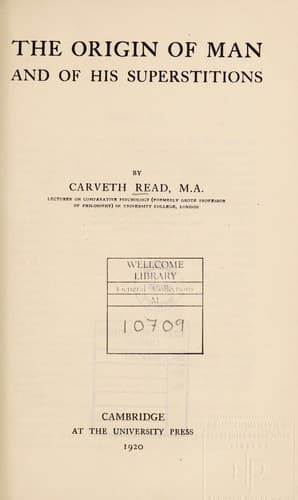
The Origin of Man and of His SuperstitionsRead, Carveth
Philosophy
The Origin of Man and of His Superstitions
Read, Carveth
Animism; Human beings -- Origin; Magic; Superstition; Totemism
Many practices of wizards involve a representation of the course of
events as something very different from the reality; and there is
no doubt that frequently, or even in most cases, wizards are aware
of this, as in performing the sucking cure or visiting the man in
the moon. But some anthropologists dislike to hear such practices
described as “fraud,” “imposture” or “deceit”; and for certain classes
of wizards it seems (as I shall show) unjust to speak in these terms
of their profession. Still, taking the profession and its actions on
the whole, it is difficult to find in popular language terms more
fairly descriptive. We meet here the inconvenience that other social or
moral sciences find when they try to use common words in a specially
restricted sense. In Economics, _e. g._, “rent,” “wages,” “profits”
have definite meanings very different from their popular acceptance. In
Ethics, what controversy, what confusion in the defining of “virtue”
and “the good”! In Metaphysics, what is the meaning of “cause”; what is
the meaning of “intuition”? The terms must be defined in each system.
If then, in these pages, the conduct of a man who, on his way to cure
a sufferer of “stitch in the side,” conceals in his mouth a piece of
bone or pebble, and after dancing, and sucking hard enough at the
patient’s belly, produces that bone or pebble as the cause of pain—is
described as “fraud,” or “imposture,” or “deceit,” the words are used
to describe the fact only, without any such imputation upon the man’s
character as they convey in popular usage. Scientifically considered,
the man and his circumstances being such as they are, his actions are a
necessary consequence; in this limited region of thought moral censure
is irrelevant.
There are some wizards, as it were in minor orders, such as Professor
Seligman calls “departmental experts,” especially the man who blesses
gardens, so earnest and harmless that no one will abuse them. They
visit the garden at the owner’s request, practise a little hocus-pocus,
mutter a few spells, take a small fee and go peaceably home. The owner
indeed supposes himself to buy fertility, and obtains only peace of
mind—a greater good say the moralists. The wizard has done what he
learnt of his father, what respectable neighbours approve of; there
is always some crop to justify his ministry, and many an evil power
to excuse occasional blight or drought. If he is convinced of being a
really indispensable man, it is easily intelligible.
Public-domain text, read in full here on John Shaqi.
Reviews
Reviews
No reviews yet
Be the first to share your thoughts on this work.
Elsewhere in the archive
Join the Discussion
Join the discussion
Sign in to leave a comment or review.
Sign InorCreate an account