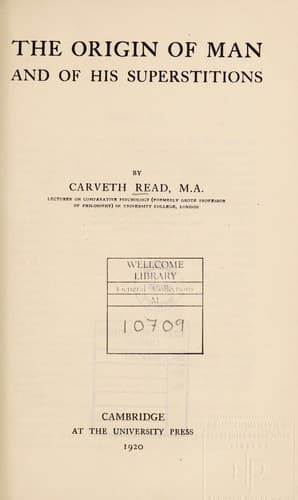
The Origin of Man and of His SuperstitionsRead, Carveth
Philosophy
The Origin of Man and of His Superstitions
Read, Carveth
Animism; Human beings -- Origin; Magic; Superstition; Totemism
As to the profession in general, a small number of wizards—wizards
by vocation—may be strongly persuaded of the genuineness of the art;
a much larger body mingles credulity in various proportions with
fraud; and not a few are deliberate cheats. Some of the greatest
masters of wizardry are dissatisfied with their own colleagues: that
eminent shaman Scratching Woman said to Bogoras the traveller, “There
are many liars in our calling.”[501] On the other hand, the wizard
who demonstrated the “pointing-stick” to Messrs. Spencer and Gillen,
and having no object upon which to discharge its Magic, thought it
had entered his own head and thereupon fell ill, was certainly a
believer;[502] and so was the wizard who felt that he had lost his
power after drinking a cup of tea, because hot drinks were taboo
to him.[503] Now a cheat needs no explanation—at least no more on
the Yenisei than on the Thames; and the variety of those who mingle
credulity with fraud is too great to be dealt with. What chiefly needs
to be accounted for is the persuasion of those who—in spite of so many
circumstances that seem to make disillusion inevitable—are in some
manner true believers—in the manner, that is to say, of imaginative
belief, founded on tradition and desire, unlike the perceptual belief
of common sense.
(_a_) Men under a vocation to wizardry, of course, begin with full
belief in it. Probably they are possessed by the imaginative and
histrionic temperament, which we have seen to be favourable to
eminence as a wizard. Their vocation consists in the warm sympathy
and emulation with which, before their own initiation, they witness
the feats of great practitioners, and which generally imply a
stirring of their own latent powers; just as many an actor has begun
by being “stage-struck.” A man of such temperament is prone to
self-delusion not only as to his own powers, but in other ways. The
wizard often begins by fasting and having visions; thereby weakening
his apprehension of the difference between fact and phantasy. The
fixed idea of his calling begets in his imagination a story of what
happened at his initiation, manifestly false, but not a falsehood—a
“rationalisation” according to wizardly ideas of what he can remember
of that time. If initiated with torture, which he endures for the sake
of his vocation, he is confirmed in it. When called upon to perform,
he “works himself up” by music, dancing and whatever arts he may have
learned or discovered, into a state of dissociation, during which his
judgment of everything extraneous to his task is suspended; and his
dramatic demeanour uninhibited by fear or shame, unembarrassed by any
second thoughts, makes, by vivid gestures and contortions and thrilling
tones, a profound impression upon patients, clients and witnesses. His
performances may derive some original traits from his own genius; but
must generally conform to a traditionary pattern and to the consequent
expectations of the audience.
Public-domain text, read in full here on John Shaqi.
Reviews
Reviews
No reviews yet
Be the first to share your thoughts on this work.
Elsewhere in the archive
Join the Discussion
Join the discussion
Sign in to leave a comment or review.
Sign InorCreate an account