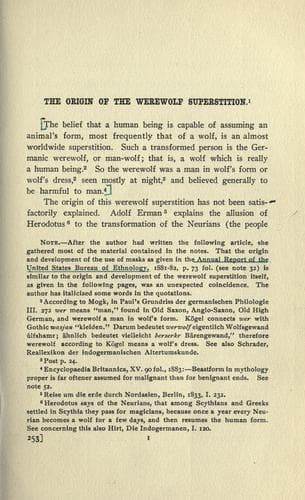
The Origin of the Werewolf SuperstitionStewart, Caroline Taylor
History
The Origin of the Werewolf Superstition
Stewart, Caroline Taylor
Werewolves
with a wolfskin to enable them to approach buffalo.” Ethn. Rep.
1901-02, p. 439;—Two of the party of hunters (Zuñi) out after
deer “wear cotton shirts with sleeves to the elbow, the front
and back of the shirt being painted to represent as nearly
as possible the body of the deer; the hands and the arms to
the elbow and also the sleeves are colored to represent the
deer’s forelegs. Each wears the skin of a deer’s head over his
head.... In this dress the two huntsmen imitate as closely as
possible, even to the browsing, the game they would catch.”
[32] Ethn. Rep. 1897-98, I. 352:—“Tradition says the Iroquois
derived the music and action of the Buffalo dance while on
an expedition against the Cherokee, from the bellowing and
the movements of a herd of buffalo which they heard for the
first time ‘singing their favorite songs,’ i. e. bellowing and
snorting.” Also note 33.
[33] Ethn. Rep. 1897-98, I. 266, gives a song to prevent
frostbite. The wolf’s, deer’s, fox’s, opossum’s feet it is held
never become frostbitten. After each verse of the song, the
singer imitates the cry and the action of the animal. The words
used are archaic in form and may be rendered “I become a real
wolf, etc.” The song runs:
1. Tsûñ´ wa´ ‘ya-ya´ (repeated four times), wa+a! (prolonged
howl). The singer imitates a wolf pawing the ground with his
feet.
2. Tsûñ´-ka´ wi-ye´ (four times), sauh! sauh! sauh! sauh!
(imitating the call and jumping of a deer).
3. Tsûñ´-tsu´ ‘la-ya´ (four times), gaih! gaih! gaih! gaih!
(imitates barking and scratching of a fox).
4. Tsûñ´-sĭ´-kwa-ya´ (four times), kĭ+(imitates cry of the
opossum when cornered, and throws his head back as that animal
does when feigning death).
[34] Ethn. Rep. 1881-82, p. 323, about the Omaha Coyote dance
performed by warriors whenever it was thought necessary to keep
up their spirits, in which each had his robe about him and
imitated the actions of the coyote, trotting, glancing around,
etc. Page 348 describes the Omaha Buffalo dance, in which each
of four men used to put the skin of a buffalo over his head,
the horns standing up, and the hair of the buffalo head hanging
down below the chest of the wearer. The various movements of
the buffalo were imitated by the dancers. Pages 348-349, the
Omaha wolf dance, by the society of those who have supernatural
communication with wolves. The dancers wear wolfskins, and
dance in imitation of the actions of wolves. Similarly they
performed the grizzly bear dance, horse dance, etc.
[35] Notes 22, 34 and 37.
[36] See notes 34 and 37.
Public-domain text, read in full here on John Shaqi.
Reviews
Reviews
No reviews yet
Be the first to share your thoughts on this work.
Join the Discussion
Join the discussion
Sign in to leave a comment or review.
Sign InorCreate an account