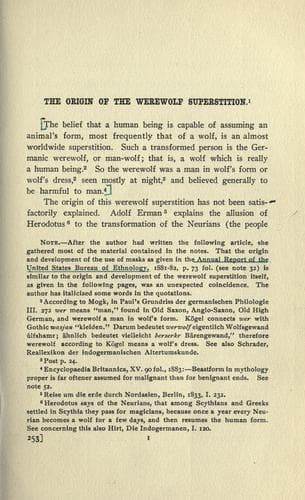
The Origin of the Werewolf SuperstitionStewart, Caroline Taylor
History
The Origin of the Werewolf Superstition
Stewart, Caroline Taylor
Werewolves
[29] Ethn. Rep. 1881-82, p. 122, note:—It seems that masks
were occasionally used as decoys.... Next to the otter the
most valuable animal in the estimation of the Kadiak men, is
the species of seal or sea-dog called by the Russians nerpa.
The easiest manner of taking it is to entice it toward the
shore. A fisherman, concealing the lower part of his body among
the rocks, puts on his head a wooden cap or rather casque
resembling the head of a seal and makes a noise like that
animal. The unsuspicious seal, imagining that he is about to
meet a partner of his own species, hastens to the spot and is
instantly killed. Compare note 57.
[30] Ethn. Rep. 1896-97, I. 132:—Bering Strait Eskimo stuff
rudely the skin of the bird called ptarmigan, and mount it upon
a stick which holds the head outstretched, then imitate the
call of the bird, which is trapped in the net attached to the
decoy. Other decoys are made by molding soft snow into the form
of a bird; for the ptarmigan, brown moss is put around the neck
for plumage. The call then brought the real birds.
[31] Thus G. B. Grinnell, Story of the Indian, p. 61, in his
description of the primitive Indians’ method of trapping
buffalo, says: “Some men went forth naked, others carried a
dress made of the entire skin of a buffalo, the head and horns
arranged like a buffalo head, while the rest of the skin hung
down over the wearer’s back,” etc. This “caller” went near to a
herd of buffalo, got them in pursuit of him, then led them into
the trap, a chute, or to a precipice, the fall from which often
proved fatal to the entire herd. Again, in Ethn. Rep. 1884-85,
p. 484, about Central Eskimo seal hunting, is stated: If a
hunter is close to an animal he imitates its movements. Some
utter sounds similar to those of a blowing seal. “The sealskin
clothing makes man and seal look so extremely alike that it is
difficult to distinguish one from the other at some distance.”
And on p. 508, about deer hunting: In a plain the Central
Eskimos carry guns on their shoulders, two men going together,
so as to resemble the antlers of a deer. The men imitate their
grunting. If they lie on the ground at some distance they
greatly resemble the animals themselves. According to Ross the
“inhabitants of Boothia imitate the appearance of the deer,
the foremost of two men stalking a herd bearing a deer’s head
upon his own.” Ethn. Rep. 1888-89, p. 534:—“The old manner of
hunting antelope and deer: the hunter would disguise himself by
covering his head with the head and skin of an antelope, and so
be enabled to approach the game near enough to use his bow and
arrow. In a similar manner the Hidatsa would mask themselves
Public-domain text, read in full here on John Shaqi.
Reviews
Reviews
No reviews yet
Be the first to share your thoughts on this work.
Join the Discussion
Join the discussion
Sign in to leave a comment or review.
Sign InorCreate an account