The Origin of the Werewolf SuperstitionStewart, Caroline Taylor
History
The Origin of the Werewolf Superstition
Stewart, Caroline Taylor
Werewolves
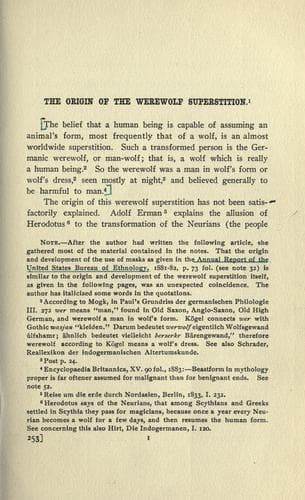
The explanation of the origin of the belief in werewolves must be one
which will apply the world over, as the werewolf superstition is found
pretty much all over the earth,[9] especially to-day[10] however in
Northwest Germany and Slavic lands; namely, in the lands where the
wolf is most common.[11][12] According to Mogk[13] the superstition
prevails to-day especially in the north and east of Germany.[14]
[9] See also Mogk in Paul’s Grundriss, III. 272. Dr. Rud.
Leubuscher, Über die Wehrwölfe und Thierverwandlungen im
Mittelalter, Berlin, 1850, mentions cases in ancient Arcadia,
in Arabia, Abyssinia (hyenas), and the almost epidemic disease
in the Middle Ages. Dr. W. Hertz, Der Werwolf, Stuttgart,
1862, ascribes the superstition to Armenia, Egypt, Abyssinia
(hyenas), Greece (pages 20-28), but not to India, contrary to
Encyc. Brit. below; on p. 133 he says: “Tierverwandlungen sind
allgemein menschlich, finden wir überall. Die eigentümliche
Entwicklung der Werwolfsagen aber finden wir vorzugsweise
bei einer bestimmten Völkergruppe, den arischen Stämmen der
Griechen, Römer, Kelten, Germanen und Slaven; bei den südwärts
gezogenen Stämmen der Inder und Iranier sind uns gleiche
Sagen nicht begegnet [but see below]. Am massenhaftesten
treten die Werwölfe bei den Slaven auf, und ihnen gehört die
älteste historische Erwähnung der Sage; viel älter aber ist
der Lykaon Mythus und arkadische Werwölfe”. According to
Andree, Ethnographische Parallelen und Vergleiche, Stuttgart,
1878, ss. 62-80, the superstition is found in every European
country (amongst Anglo-Saxons, English, French, Bretons, Poles,
Tschechs, Lithuanians, White Russians of Poland, inhabitants
of island Oesel, Russians, Italians, Portuguese, Provencal
peoples, Greeks, Kelts, in Asia, Africa, America; but not in
India nor Persia, contrary to Encyc. Brit. below), especially
though in northwestern Germany and in Slavic lands.
As to the American Indians, see Ethnological Report for
1880-81, p. 83, “From their close relations with wild animals
Indians’ stories of transformations into beasts and beasts
into men are numerous and interesting.... In times of peace,
during the long winter evenings, some famous storyteller told
of those days in the past when men and animals could transform
themselves at will and hold converse with one another.”
Jacob Grimm, Teutonic Mythology, Bell & Sons, 1883, II. 668
says no metamorphosis occurs more frequently in Germanic
antiquities than that of men into werewolves. Thus Fenrisûlfr,
a son of Loki, makes his appearance in wolf’s shape among the
gods.
Public-domain text, read in full here on John Shaqi.
Reviews
Reviews
No reviews yet
Be the first to share your thoughts on this work.
Join the Discussion
Join the discussion
Sign in to leave a comment or review.
Sign InorCreate an account