The Origin of the Werewolf Superstition — John Shaqi
The Origin of the Werewolf SuperstitionStewart, Caroline Taylor
History
The Origin of the Werewolf Superstition
Stewart, Caroline Taylor
Werewolves
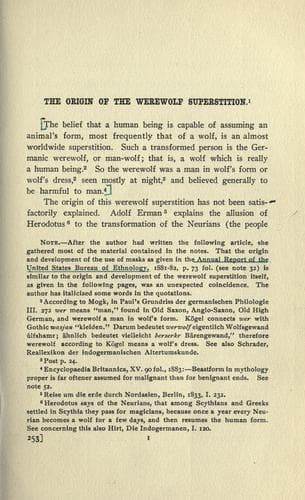
Encyc. Brit. XV. 89 fol., under the heading Lycanthropy,
states:—A belief firmly rooted among all savages is that
men are in certain circumstances transformed temporarily or
permanently into wolves and other inferior animals. In Europe
the transformation into a wolf is by far more prominent and
frequent (amongst Greeks, Russians, English, Germans, French,
Scandinavians). Belief in metamorphosis into the animal most
prominent in any locality itself acquires a special prominence.
Thus the were-_wolf_ prevails in Europe, also in England,
Wales, Ireland; and in S. France, the Netherlands, Germany,
Lithuania, Bulgaria, Servia, Bohemia, Poland, Russia, he can
hardly be pronounced extinct now (see note 12). In Denmark,
Sweden, Norway and Iceland the _bear_ competes with the wolf
for pre-eminence. In Persia the _bear_ is supreme; in Japan the
_fox_; in India the _serpent_ vies with the _tiger_ (contrary
to Mogk in Paul’s Grd., III. 272, who says:—“Nur Griechen,
Römer, Kelten, Germanen, Slaven unter den indogermanischen
Völkern kennen den Werwolf, den Indern und Iraniern ist er
unbekannt.” Compare notes 6 and 9, Hertz, p. 133); in Abyssinia
and Borneo the _hyena_ with the _lion_; in E. Africa the _lion_
with the _alligator_; in W. Africa the _leopard_ is perhaps
most frequently the form assumed by man; among the Abipones the
_tiger_, among the Arawaks the _jaguar_, etc.
In Brockhaus’ Konversations-Lexikon, for the Middle Ages the
werewolf belief is ascribed to all Slavic, Keltic, Germanic and
Romanic peoples; found to-day especially in Volhynia and White
Russia.
Paul, Grundriss, III. 272:—Bei den Angelsachsen lässt sich der
Werwolf im 11. Jahrh. nachweisen: Knut befahl den Priestern,
ihre Herden vor dem werewulf zu schirmen.... Das älteste
Zeugnis auf deutschem Gebiete vom Werwolf ist vom Burchard v.
Worms (11 century).
[10] See note 9.
[11] Encyc. Brit. XV. 89 fol.:—There can nowhere be a living
belief in contemporary metamorphosis into any animal which
has ceased to exist in the particular locality. Belief in
metamorphosis into the animal most prominent in any locality
itself acquires a special prominence. (See note 12.) In none
of these cases however is the power of transformation limited
exclusively to the prominent and dominant animal.
[12] Encyc. Brit. XXIV. 628 fol. under _Wolf_:—The wolf is
found in nearly the whole of Europe and Asia, North America
from Greenland to Mexico, the Indian peninsula, but not in
Ceylon, Burmah or Siam; and not in South America or Africa, in
the two latter jackals instead.
Public-domain text, read in full here on John Shaqi.
Reviews
Reviews
No reviews yet
Be the first to share your thoughts on this work.
Join the Discussion
Join the discussion
Sign in to leave a comment or review.
Sign InorCreate an account