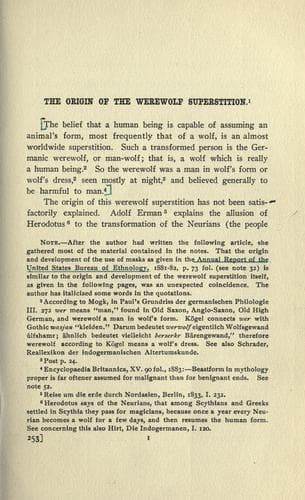
The Origin of the Werewolf SuperstitionStewart, Caroline Taylor
History
The Origin of the Werewolf Superstition
Stewart, Caroline Taylor
Werewolves
[86] Encyc. Brit., XV. under Lycanthropy: In Prussia, Livonia
and Lithuania, according to two bishops, werewolves were in
the 16th century far more destructive than “true and natural
wolves.” They were asserted to have formed “an accursed
college” of those “desirous of innovations contrary to the
divine law.” Also see note 90.
[87] See ante p. 13, and notes 64, 65, 66, 69, 84, 102, 110.
[88] Note 22 close, and note 102.
[89] See ante p. 13.
[90] Andree, p. 72. This same tiger-man in Asia killed a
woman, whose husband set out in pursuit, followed him to his
house, got hold of him later in his man shape and killed him.
Feats similar to some performed by him are cited in Ethn. Rep.
1887-88, p. 470: The medicine-men of the Pawnee swallowed
arrows and knives, and also performed the trick of apparently
killing a man and bringing him back to life, like the Zuñi.
[91] Grimm, Rechtsalterthümer, II. 566: Hexen waren fast alle
aus der ärmsten und niedrigsten Volksklasse (see note 84).
Literary Digest, March 9, 1907, p. 378, article on Spiritualism
and Spirituality: “Many, very many, spiritualists seem to care
for communion with spirits only that they may more surely keep
physically well, and earn their bread and butter and clothing
the easier.” Encyc. Brit. under Lycanthropy: The absurdity of
the superstition would have much sooner appeared, but for the
theory that a werewolf when wounded resumed human shape; in
every case where one accused of being a werewolf was taken, he
was certain to be wounded, and thus the difficulty of his not
being found in beast form was satisfactorily disposed of.
[92] Notes 57 and 67.
Public-domain text, read in full here on John Shaqi.
Reviews
Reviews
No reviews yet
Be the first to share your thoughts on this work.
Join the Discussion
Join the discussion
Sign in to leave a comment or review.
Sign InorCreate an account