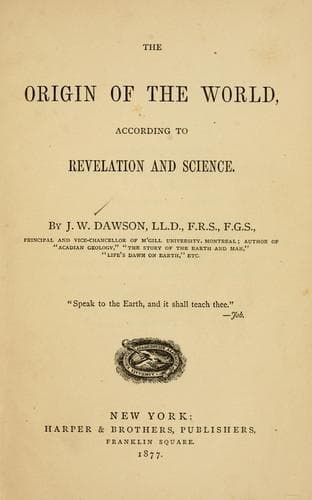
The Origin of the World According to Revelation and ScienceDawson, John William, Sir
Religion
The Origin of the World According to Revelation and Science
Dawson, John William, Sir
Bible and science; Religion and science
This corresponds to the work of the first four creative days; and next
details are given as to the introduction of animals, with which,
however, the Creator is represented as dissatisfied, because they
could not know or invoke the Creator. They are therefore condemned to
be subject to be devoured one of another. Again there is a council in
heaven, and the gods determine to make man. But he also is imperfect,
for he has speech without intelligence: so he is condemned to be
destroyed by water. A new council is held, and a second race of men
produced; but this fails in the capacity for religious worship--"they
forgot the Heart of Heaven." These were partly destroyed by fire and
partly converted into apes. Lastly another council is held, and
perfect men created. Then follows a remarkable series of stories
relating to the early history and migrations of men.
It is known that similar creation myths existed among the Mexicans
and other early civilized nations of America, and in ruder and more
grotesque forms even among the semi-barbarous and hunter tribes. Their
connection with the ancient Semitic and Turanian revelations of Asia
is unquestionable.
We have thus in the Assyrian Genesis a relic of early religious belief
belonging to a period when such widely separated stocks as the
Assyrian and American were still one: to a period, therefore,
presumably long anterior to that of Moses. Yet at this very early
period the central portions at least of the Turanian race had already
devised some means of recording their traditions in writing--probably
the arrow-head writing, afterwards used by the Assyrians, had already
been invented. Again, at this early period a complex polytheism had
already sprung up, and this was connected with cosmological ideas,
inasmuch as the primitive abyss, the firmament, the starry heavens,
the principle of life, were all subordinate gods; and so were also
some of the earliest of the patriarchs of the human race. It is
possible, however, that this was among the early Chaldeans an exoteric
representation for the vulgar, and that the priestly caste may have
understood it in a monotheistic sense. In any case, the idea of a
Supreme Creator remains behind the whole. Farther, in the early
Chaldean record we have a more detailed and expanded document than
that of the Hebrew Genesis, probably intended for the popular ear, and
to include as much as possible of the current mythology. As an
example, I quote the following in relation to the creation of the
moon, being apparently a part of the narrative of that creative period
corresponding with the fourth day of Genesis:
Public-domain text, read in full here on John Shaqi.
Reviews
Reviews
No reviews yet
Be the first to share your thoughts on this work.
Join the Discussion
Join the discussion
Sign in to leave a comment or review.
Sign InorCreate an account