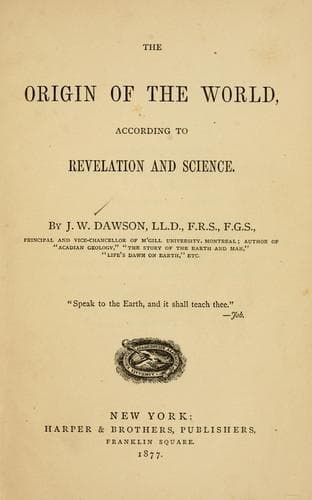
The Origin of the World According to Revelation and ScienceDawson, John William, Sir
Religion
The Origin of the World According to Revelation and Science
Dawson, John William, Sir
Bible and science; Religion and science
"In its mass [that is, of the lower chaos] he made a boiling,
The God Uru [the moon] he caused to rise out, the night he
overshadowed.
To fix it also for the light of the night until the shining of
the day,
That the month might not be broken and in its amount be regular.
At the beginning of the month at the rising of the night,
His horns are breaking through to shine in the heavens.
On the seventh day to a circle he begins to swell,
And stretches toward the dawn farther."
We now come to the historical connection of all this with Abraham and
with the Hebrew Scriptures. The early life of the "Father of the
Faithful" belongs to the time when Turanian and Semitic elements were
mingled in the Euphratean valley. Himself of the stock of Shem, he
dwelt in Ur of the Chaldees, a city in whose ruins, now known by the
name of Mugheir, Chaldean inscriptions have been found of a date
anterior to that of the patriarch. In the time of Abraham a
polytheistic religion already existed in Ur, for we are told that his
father "served other gods." Further, the legends of the creation and
the deluge, and the antediluvian age, with the history of Nimrod and
other postdiluvian heroes, existed in a written form; and, strange
though this may seem, there can be little doubt that Abraham, before
he left Ur of the Chaldees, had read the same creation legends that
have so recently been translated and published by Mr. Smith. But
Abraham's relation to these was of a peculiar kind. With a spiritual
enlightenment beyond that of his age, he dissented from the Turanian
animism and polytheism, and maintained that pure and spiritual
monotheism which, according to the Bible, had been the original faith
of the sons of Noah. But he was overborne by the tendencies of his
time, and probably by the royal and priestly influence then dominant
in Chaldea, and he went forth from his native land in search of a
country where he might have freedom to worship God. It is thus that
Abraham appears as the earliest reformer, the first of those martyrs
of conscience who fear not to differ from the majority, the father and
prototype of the faithful of every age, and the earliest apostle of
the monotheistic faith which still reigns among all the higher races
of men.
Public-domain text, read in full here on John Shaqi.
Reviews
Reviews
No reviews yet
Be the first to share your thoughts on this work.
Join the Discussion
Join the discussion
Sign in to leave a comment or review.
Sign InorCreate an account