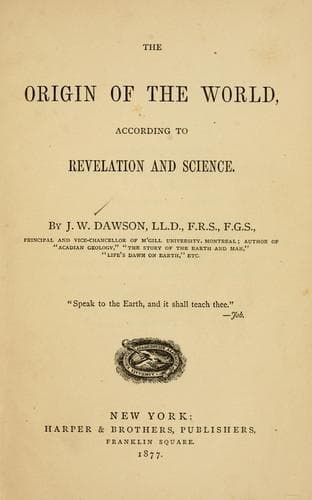
The Origin of the World According to Revelation and ScienceDawson, John William, Sir
Religion
The Origin of the World According to Revelation and Science
Dawson, John William, Sir
Bible and science; Religion and science
Did Abraham take with him in his pilgrimage the records of his people?
It is scarcely possible to doubt that he did, and this probably in a
written form, but purified from the polytheism and inane imaginations
accreted upon them; or perhaps he had access to still older and more
primitive records anterior to the rise of the Turanian superstitions.
In any case we may safely infer that Abraham and his tribe carried
with them the substance of all that part of Genesis which contains the
history of the world up to his time, and that this would be a precious
heir-loom of his family, until it was edited and incorporated in the
Pentateuch by his great descendant Moses. It seems plain, therefore,
that the original prophet or seer to whom the narrative of creation
was revealed lived before Abraham, but we need not doubt that the
latter had the benefit of divine guidance in his noble stand against
the idolatry of his age, and in his selection of the documents on
which his own theology was based. These considerations help us to
understand the persistence of Hebrew monotheism in the presence of the
idolatries of Canaan and Egypt, since these were closely allied to the
Chaldean system against which Abraham had protested. They also explain
the recognition by Abraham, as co-religionists, of such monotheistic
personages as Melchisedec, king of Salem. They further illustrate the
nature of the religious basis in his people's beliefs on which Moses
had to work, and on which he founded his theocratic system.
Before leaving this part of the subject, I would observe that the view
above given; while it explains the agreement between the Hebrew
Genesis and other ancient religious beliefs, is in strict accordance
with the teachings of Genesis itself. The history given there implies
monotheism and knowledge of God as the Creator and Redeemer, in
antediluvian and early postdiluvian times, a decadence from this into
a systematic polytheism at a very early date, the protest and dissent
of Abraham, his call of God to be the upholder of a purer faith, and
the maintenance of that faith by his descendants. Besides this, any
careful reader of Genesis and of the book of Job, which, whatever its
origin, must be more ancient than the Mosaic law, will readily
discover indications that Abraham and the patriarchs were in the
possession of documents and traditions of the same purport with those
in the early chapters of Genesis, and that these were to them their
only sacred literature. The reader of the Pentateuch must carry this
idea with him, if he would have any clear conception of the unity and
symmetry of these remarkable books.
THE MOSAIC GENESIS.
Public-domain text, read in full here on John Shaqi.
Reviews
Reviews
No reviews yet
Be the first to share your thoughts on this work.
Join the Discussion
Join the discussion
Sign in to leave a comment or review.
Sign InorCreate an account