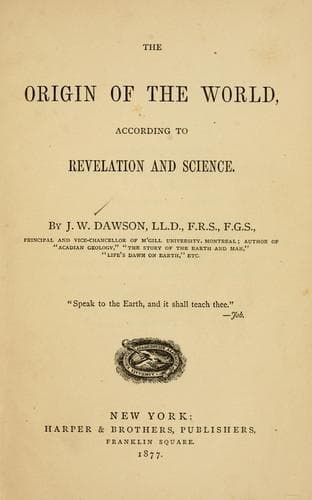
The Origin of the World According to Revelation and Science — John Shaqi
The Origin of the World According to Revelation and ScienceDawson, John William, Sir
Religion
The Origin of the World According to Revelation and Science
Dawson, John William, Sir
Bible and science; Religion and science
What, then, are we to say of the imaginary "conflict of science with
religion," of which so much has been made? Simply that it results
largely from misapprehension and from misuse of terms. True religion,
which consists in practical love to God and to our fellow-men, can
have no conflict with science. True science is its fast ally. The
Bible, considered as a revelation of spiritual truth to man for his
salvation and enlightenment, can have no conflict with science. It
promotes the study of nature, rendering it honorable by giving it the
dignity of an inquiry into the ways of God, and rendering it safe by
separating it from all ideas of magic and necromancy. It gives a
theological basis to the ideas of the unity of nature and of natural
law. The conflict of science, when historically analyzed, is found to
have been fourfold--with the Church, with theology, with superstition,
and with false or imperfect science and philosophy. Religious men may
have identified themselves from time to time with these opponents, but
that is all; and much more frequently the opposition has been by bad
men more or less professing religious objects. Organizations calling
themselves "the Church," and whose warrant from the Bible is often of
the slenderest, have denounced and opposed and persecuted new
scientific truths; but they have just as often denounced the Bible
itself, and religious doctrines founded on it. Theology claims to be
itself one of the sciences, and as such it is necessarily imperfect
and progressive, and may at any time be more or less in conflict with
other sciences; but theology is not religion, and may often have very
little in common either with true religion or the Bible. When
discussions arise between theology and other sciences, it is only a
pity that either side should indulge in what has been called the
_odium theologicum_, but which is unfortunately not confined to
divines. Superstition, considered as the unreasonable fear of natural
agencies, is a passive rather than an active opponent of science. But
revelation, which affirms unity, law, and a Father's hand in nature,
is the deadly foe of superstition, and no people who have been readers
of the Bible and imbued with its spirit have ever been found ready to
molest or persecute science. Work of this sort has been done only by
the ignorant, superstitious, and priest-ridden votaries of systems
which withhold the Bible from the people, and detest it as much as
they dislike science. Perhaps the most troublesome opposition to
science, or rather to the progress of science, has sprung from the
tenacity with which men hold to old ideas. These, which may have been
at one time the best science attainable, root themselves in popular
literature, and even in learned bodies and in educational books and
institutions. They become identified with men's conceptions both of
nature and religion, and modify their interpretations of the Bible
itself. It thus becomes a most difficult matter to wrench them from
Public-domain text, read in full here on John Shaqi.
Reviews
Reviews
No reviews yet
Be the first to share your thoughts on this work.
Join the Discussion
Join the discussion
Sign in to leave a comment or review.
Sign InorCreate an account