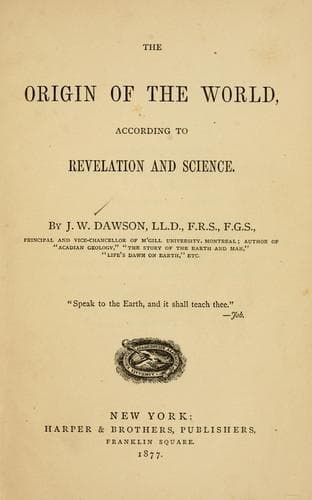
The Origin of the World According to Revelation and ScienceDawson, John William, Sir
Religion
The Origin of the World According to Revelation and Science
Dawson, John William, Sir
Bible and science; Religion and science
men's minds, and their advocates are too apt to invoke in their
defense political, social, and ecclesiastical powers, and to seek to
support them by the authority of revelation, when this may perhaps be
quite as favorable to the newer views opposed to them. All these
conflicts are, however, necessary incidents in human progress, which
comes only by conflict; and there is reason to believe that they would
be as severe in the absence of revealed religion as in its presence,
were it not that the absence of revelation seems often to produce a
fixity and stagnation of thought unfavorable to any new views, and
consequently to some extent to any intellectual conflict. It has been,
indeed, to the disinterment of the Bible in the Reformation of the
fifteenth century that the world owes, more than to any other cause,
the immense growth of modern science, and the freedom of discussion
which now prevails. The Protestant idea of individual judgment in
matters of religion is thoroughly Biblical, for the Bible everywhere
appeals to men in this way; and this idea is the strongest guarantee
that the world possesses for intellectual liberty in other matters.
We conclude, therefore, on all these grounds, that it was necessary
that a revelation from God should take strong and positive ground on
the question of the origin of the universe.
* * * * *
(2) _The Origin, Method, and Structure of the Scriptural
Cosmogony._--A respectable physicist, but somewhat shallow naturalist
and theologian, whose works at one time attracted much attention, has
said of the first chapter of Genesis: "It can not be history--it may
be poetry." Its claims to be history we shall investigate under
another head, but it is pertinent to our present inquiry to ask
whether it can be poetry. That its substance or matter is poetical no
one who has read it once can believe; but it can not be denied that in
its form it approaches somewhat to that kind of thought-rhythm or
parallelism which gives so peculiar a character to Hebrew poetry. We
learn from many Scripture passages, especially in the Proverbs, that
this poetical parallelism need not necessarily be connected with
poetical thought; that in truth it might be used, as rhyme is
sometimes with us, to aid the memory. The oldest acknowledged verse in
Scripture is a case in point. Lamech, who lived before the flood,
appears to have slain a man in self-defense, or at least in an
encounter in which he himself was wounded; and he attempts to define
the nature of the crime in the following words:
"Adah and Zillah, hear my voice;
Ye wives of Lamech, hearken to my speech:--
I have slain a man to my wounding,
And a young man to my hurt;
If Cain shall be avenged sevenfold,
Truly Lamech seventy and seven fold."
Public-domain text, read in full here on John Shaqi.
Reviews
Reviews
No reviews yet
Be the first to share your thoughts on this work.
Join the Discussion
Join the discussion
Sign in to leave a comment or review.
Sign InorCreate an account