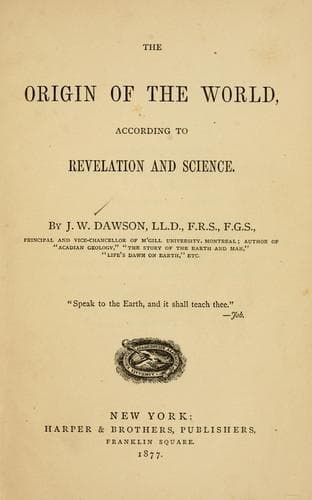
The Origin of the World According to Revelation and ScienceDawson, John William, Sir
Religion
The Origin of the World According to Revelation and Science
Dawson, John William, Sir
Bible and science; Religion and science
The problem here set to the "unknown" author of Genesis is a hard
one--given the one fact that "man is" to find in detail how the world
was formed in a series of preceding ages of vast duration. Is it
possible that such a problem could have been so worked out as to have
endured the test of three thousand years, and the scrutiny of modern
science? But there is an "oversight" in one detail, and a "blunder" in
another. By reference farther on, the reader will find under the
chapters on "Light" and the "Atmosphere" that the oversight and
blunder are those not of the writer of Genesis, but of the learned
American ethnologists in the nineteenth century; a circumstance which
cuts in two ways in defense of the ancient author so unhappily unknown
to his modern critics.
The second of the alternatives above referred to, the mythical
hypothesis, has been advanced and ably supported, especially on the
continent of Europe, and by such English writers as are disposed to
apply the methods of modern rationalistic criticism to the Bible. In
one of its least objectionable forms it is thus stated by Professor
Powell:
"The narrative, then, of six periods of creation, followed by a
seventh similar period of rest and blessing, was clearly designed by
adaptation to their conceptions to enforce upon the Israelites the
institution of the Sabbath; and in whatever way its details may be
interpreted, it can not be regarded as an _historical_ statement of
the _primeval_ institution of a Sabbath; a supposition which is indeed
on other grounds sufficiently improbable, though often adopted. * * *
If, then, we would avoid the alternative of being compelled to admit
what must amount to impugning the truth of those portions at least of
the Old Testament, we surely are bound to give fair consideration to
the only suggestion which can set us entirely free from all the
difficulties arising from the geological contradiction which does and
must exist against any conceivable interpretation which retains the
assertion of the historical character of the details of the narrative,
as referring to the distinct transactions of each of the seven
periods. * * * The one great fact couched in the general assertion
that all things were created by the sole power of one Supreme Being is
the whole of the representation to which an historical character can
be assigned. As to the particular form in which the descriptive
narrative is conveyed, we merely affirm that it can not be history--it
may be poetry."[14]
Public-domain text, read in full here on John Shaqi.
Reviews
Reviews
No reviews yet
Be the first to share your thoughts on this work.
Join the Discussion
Join the discussion
Sign in to leave a comment or review.
Sign InorCreate an account