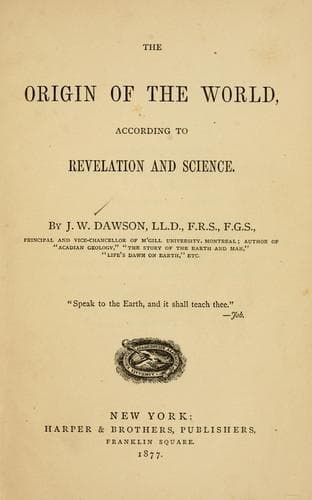
The Origin of the World According to Revelation and ScienceDawson, John William, Sir
Religion
The Origin of the World According to Revelation and Science
Dawson, John William, Sir
Bible and science; Religion and science
But it may be affirmed that in the Bible long and undefined periods
are indicated by the word "day." In many of these cases the word is in
the plural: as Genesis iv., 3, "And after days it came to pass,"
rendered in our version "in process of time;" Genesis xl., 4, "days in
ward," rendered "a season." Such instances as these are not applicable
to the present question, since the plural may have the sense of
indefinite time, merely by denoting an undetermined number of natural
days. Passages in which the singular occurs in this sense are those
which strictly apply to the case in hand, and such are by no means
rare. A very remarkable example is that in Genesis ii., 4, already
mentioned, where we find, "In the day when Jehovah Elohim made the
earth and the heavens." This day must either mean the beginning, or
must include the whole six days; most probably the latter, since the
word "made" refers not to the act of creation, properly so called, but
to the elaborating processes of the creative week; and occurring as
this does immediately after the narrative of creation, it seems almost
like an intentional intimation of the wide import of the creative
days. It has been objected, however, that the expression "in the day"
is properly a compound adverb, having the force of "when" or "at the
time." But the learned and ingenious authors who urge this objection
have omitted to consider the relative probabilities as to whether the
adverbial use had arisen while the word _yom_ meant simply a day, or
whether the use of the noun for long periods was the reason of the
introduction of such an adverbial expression. The probabilities are in
favor of the latter, for it is not likely that men would construct an
adverb referring to indefinite time from a word denoting one of the
most precisely limited portions of time, unless that word had also a
second and more unlimited sense. Admitting, therefore, that the phrase
is an adverb of time, its use so early as the date of the composition
of Genesis, to denote a period longer than a literal day, seems to
imply that this indefinite use of the word was of high antiquity, and
probably preceded the invention of any term by which long periods
could be denoted.
Public-domain text, read in full here on John Shaqi.
Reviews
Reviews
No reviews yet
Be the first to share your thoughts on this work.
Elsewhere in the archive
Join the Discussion
Join the discussion
Sign in to leave a comment or review.
Sign InorCreate an account