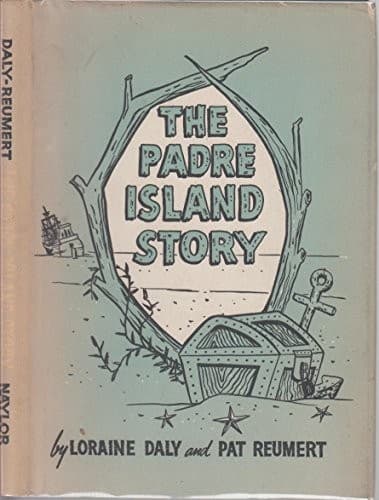
Padre Island (Tex.); Rio Grande Valley (Colo.-Mexico and Tex.) -- Description and travel
Pirate Jean Lafitte, hero of the War of 1812, and scoundrel of the seas,
held court over his renegade colony of outlaws on Padre, and added more
legend to the notorious past of Lady Padre. During his reign, he amassed
a fortune by preying on Spanish treasure ships. Many a sea adventurer
met his death on the shores of Padre because of the treachery and
cunning of these devious shipwreckers. These scoundrels would set up
lights on the island to confuse the seamen’s course and lure the ships
into shallow waters nearby. The vessels would run aground or become
wrecked, and the pirates would steal their cargo. Lafitte and his one
thousand followers finally settled on Galveston Island. One day he
sailed away with a handpicked crew and was never heard of again. It is
said that many of the most solid, respectable family trees, just a
stone’s throw from Padre Island, sprouted from the buccaneers left
behind.
One of the first white men to actually lay claim to the island was a
Catholic priest, Padre Nicolás Balli, who obtained sovereign right to it
from the Spanish crown about 1800. He came to Padre to convert the
Indians to Christianity. Father Balli then established a mission and
ranch near the center of the island, calling his settlement “Rancho
Santa Cruz.” In 1827, to substantiate Father Balli’s claim, the island
was surveyed with braided rawhide cords. Padre Island became his
namesake. Earlier the island had been called Isla Blanca (White Island),
although the northern end was also called Isla de Corpus Christi, and
the southern end San Carlos de las Malaguitas. The good Father,
unfortunately, had little luck in converting the Indians. The last of
the family to which Padre Balli belonged left the island in 1844.
For three years the island remained deserted, until still another
episode in its colorful history unfolded with the wrecking of the
three-masted schooner of the illustrious Singer family, of sewing
machine fame. Captain of the ship was John Singer, brother of the
founder of the Singer Sewing Machine Company. John Singer then built a
house, brought cattle from the mainland, and raised a family at Rancho
Santa Cruz, the same site used earlier by Father Balli. It is
interesting to note that here, on Padre Island, was used the first
sewing machine in Texas, for Singer’s wife was sent one as a gift from
her husband’s brother. John Singer reigned over the Rancho Santa Cruz
village and cattle ranch until the Civil War, when, because of his
Unionist sympathies, Singer was forced to leave.
Public-domain text, read in full here on John Shaqi.
Reviews
Reviews
No reviews yet
Be the first to share your thoughts on this work.
Join the Discussion
Join the discussion
Sign in to leave a comment or review.
Sign InorCreate an account