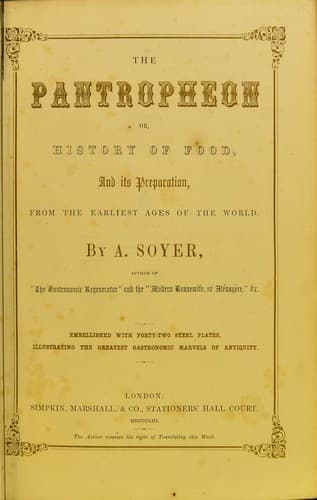
The Pantropheon; Or, History of Food, Its Preparation, from the Earliest Ages of the WorldSoyer, Alexis
History
The Pantropheon; Or, History of Food, Its Preparation, from the Earliest Ages of the World
Soyer, Alexis
Cooking; Food; Gastronomy
This warlike bird has never enjoyed a high culinary reputation;
nevertheless, it was eaten when old, that is to say, at that period of
its life when its flesh, hard, fibrous, and tough, possesses neither
juice nor flavour--then this wretched food was left to those among the
common people who joyously feasted in the drinking-shops of Rome. They,
however, always avoided making fricassees of white cocks, because they
were consecrated to the month, and proclaimed the hours.[XVII-11]
THE CAPON.
The cock being banished from the table of all respectable people, the
necessity of dressing hens became evident, for it was necessary to live.
Now, you are aware that there are two sorts of hens; one sort
consumptive looking and tough, the other tender, plump, and before which
an epicure banishes every other thought, and sighs with pleasure. These
last were preferred, and, in order to render them more worthy of the
voluptuous epicures for whom they were intended, they learned from the
inhabitants of the island of Cos the art of fattening them in dark and
closed places, with certain wonderful pastes, which increased their
delicacy and tempting whiteness.[XVII-12]
This ingenious invention belonged to Greece and Asia. Rome possessed
herself of it, and even improved it; but soon the constant tyrant of the
kitchen, the Consul, C. Fannius, who thought bad what others thought
good, and who pretended that in consequence of the immense consumption
made of them, the result would be that not a living hen would be left in
the empire, ordered that for the future the Romans should dispense with
fattening and eating this delicious winged animal.[XVII-13]
Fortunately, the law said nothing about young cocks; this silence saved
Roman gastronomy, and the capon was invented.[XVII-14] It is not
necessary to relate with what transports of delight this new creation
was greeted; it will be easily understood. Rome was moved; the famous
Greek cooks, who consecrated their science to _her_, were on tip-toe.
Everywhere, from mouth to mouth, spread the name of the skilful
enchanter, who could in such a manner metamorphose the clarion of the
farm yard. Fannius, himself, it is said, wished to be assured of the
truth of the prodigy: he was served with a roast capon, and the praises
he bestowed on it were assuredly the triumph of the bird, of epicures,
and of art.[XVII-15] From this remarkable epoch, nearly all chickens
underwent the ingenious transformation which rendered them so welcome to
all Lucullian tables;[XVII-16] and it caused such a destruction of
birds, that the consul repented, but too late, that he had only named
hens in his sumptuary law.
Public-domain text, read in full here on John Shaqi.
Reviews
Reviews
No reviews yet
Be the first to share your thoughts on this work.
Elsewhere in the archive
Join the Discussion
Join the discussion
Sign in to leave a comment or review.
Sign InorCreate an account