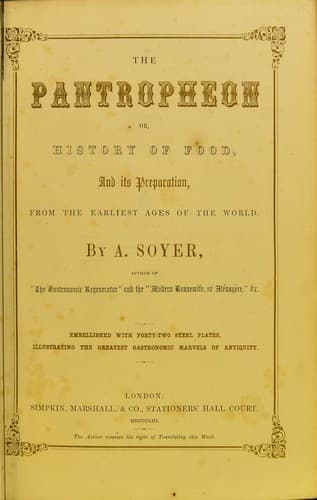
The Pantropheon; Or, History of Food, Its Preparation, from the Earliest Ages of the WorldSoyer, Alexis
History
The Pantropheon; Or, History of Food, Its Preparation, from the Earliest Ages of the World
Soyer, Alexis
Cooking; Food; Gastronomy
The wings and neck of the goose also acquired some favour; the feet were
added, when Messalinus had taught how to peel them by passing them
rapidly over the fire, and then preparing them with cocks’ combs. The
remainder was only good for the common people.[XVII-74]
Stuffed goslings also enjoyed a reputation among the Greeks,[XVII-75]
who fattened them by giving them, three times a day, during a month, a
mixture of bran and flour, moistened with hot water (two parts of flour
and four parts of bran); but, if Palladius is to be believed, it is much
better to feed them solely with millet, and as much water as they may
require.[XVII-76]
_Sejus Seasoning._--Bruise pepper, alisander, coriander, mint, and rue;
mix with it garum and a little oil; pour it over the roast goose, and
serve.[XVII-77]
_Apician Seasoning for a Roast Goose’s Liver._--Crush in a mortar, and
then well mix, pepper, carrots, cummin, parsley-seed, thyme, onions,
benzoin root, and fried pine nuts; add honey, vinegar, garum, and oil,
and serve with the roast liver in the omentum.[XVII-78]
_Boiled Goose à la Gauloise._--Boil a goose with garum, oil, wine, a
bunch of leeks, coriander, and savory; then crush pepper and pine nuts,
to which put a little water. Then take the leeks, coriander, and savory
out of the saucepan; put in their place the mixture mentioned, add some
milk, boil it, thicken with whites of eggs, and serve.[XVII-79]
In the sixteenth century they had dark cages, in which they fattened
poultry with ground tares, wheaten flour, and barley meal. Capons
fattened in hutches, where they could not turn, nor even stir, were
esteemed delicious. They fed pigeons on the crumb of bread, steeped in
wine; peacocks on the sediment from cider.
On Michaelmas Day, the 29th of September, many persons in England eat
roast goose for their dinner. It is said that this custom dates from the
time of Queen Elizabeth, who was being served with a piece of goose on
Michaelmas Day, at the very moment when news was brought of the defeat
of the famous Armada. Some persons affirm that the Queen expressed a
desire that this dish might, each year, serve to perpetuate the
remembrance of so signal a victory. Would it not be more simple to
suppose that Elizabeth herself already conformed to a custom which had
existed before her time?[XVII-80]
At Mans, instead of letting the poultry eat freely, they are shut up in
a dark place, and made to swallow pellets of about two inches long and
one thick, composed of two parts of barley flour, and one of maize, made
with sufficient quantity of milk.
“In the time when the French had a decided taste for spices and
aromatics, they imagined to vary at will the flavour and perfume of the
flesh of fowls. With the paste used to fatten them was mixed musk,
anise-seed, and comfits, with other aromatic drugs. A Queen was known
to spend 1,500 francs (£60) in fattening three geese, whose livers she
wished to render more delicate.”--PARMENTIER.
THE PIGEON.
Public-domain text, read in full here on John Shaqi.
Reviews
Reviews
No reviews yet
Be the first to share your thoughts on this work.
Elsewhere in the archive
Join the Discussion
Join the discussion
Sign in to leave a comment or review.
Sign InorCreate an account