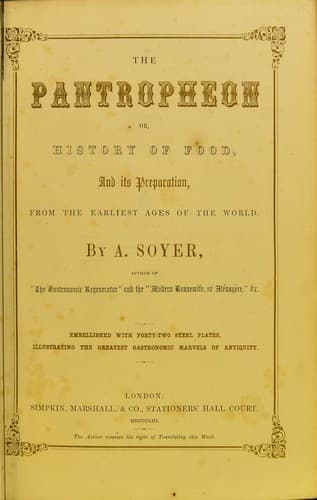
The Pantropheon; Or, History of Food, Its Preparation, from the Earliest Ages of the WorldSoyer, Alexis
History
The Pantropheon; Or, History of Food, Its Preparation, from the Earliest Ages of the World
Soyer, Alexis
Cooking; Food; Gastronomy
The dove, a bird so dear to Venus,[XVII-81] served ambrosia to
Jupiter,[XVII-82] and became the interpreter of Dodona’s
oracles.[XVII-83] Several nations consecrated it to their gods.[XVII-84]
The Jews discovered in it the image of the sweetest virtues,[XVII-85] of
beauty, innocence, and purity;[XVII-86] and they sacrificed it to the
Almighty, as a burnt offering agreeable to His unspeakable
holiness.[XVII-87]
This was because the dove or pigeon (begging pardon, here, for mixing
varieties) is to the hawk, according to an expression of a father of the
Church, what the lamb is to the wolf,[XVII-88]--a symbol of good by the
side of evil, or of a calm and peaceful conscience, as opposed to the
sad and agitated criminal. But, alas! the ancient prerogatives of this
tender bird, its candour and innocence, could not even preserve it from
the fate common to almost everything which breathes. Its delicate
flesh--fatal gift of Heaven!--recommended it to the epicure; not for its
poetical qualities, but for its delicate flavour; and, after many songs
of praise, it was condemned to be roasted.
From the beginning of the heroic ages, pigeons were caught with snares
and nets,[XVII-89] in order to feed them, and be able to procure some at
once, if required to be served at a repast; for they formed a dainty
dish upon the tables of the most fastidious.[XVII-90] Of course they
figured in the joyous wedding feast of that opulent Caranus who
entertained his guests so sumptuously.[XVII-91]
The Greeks, therefore, used to bring up an immense number of pigeons,
and built for them, in the most open situations, charming pigeon-houses,
in the form of small towers, models of elegance and cleanliness, where
those timid birds found at night a retreat, always fatal to some one
amongst them.[XVII-92]
The Romans introduced in these sorts of edifices the most unusual
luxury.[XVII-93] Each kind of pigeon had a particular home[XVII-94]--a
foolish and expensive taste, which they continually attempted to
embellish. It was, however, a profitable speculation for those who knew
how to be satisfied with pigeon-houses of more simple appearance. A
brace of rather ordinary pigeons did not cost less than 16s.: the finest
were sold at £4 a pair. It is even known that L. Axius, a Roman knight,
demanded and obtained £6 8_s._ for two young pigeons intended for a
patrician’s table.[XVII-95]
Physicians of that period greatly praised the flesh of these birds; they
recommended it to the sick and convalescent.[XVII-96]
_Roast Pigeon, with Servilian Seasoning._--Bruise some dill seeds, dried
mint, and the root of benzoin; add some vinegar, dates, garum, a little
mustard, and oil; stir well; then mix with it some wine reduced to half,
and pour the whole on the roasted pigeon.[XVII-97]
THE GUINEA HEN.
Public-domain text, read in full here on John Shaqi.
Reviews
Reviews
No reviews yet
Be the first to share your thoughts on this work.
Elsewhere in the archive
Join the Discussion
Join the discussion
Sign in to leave a comment or review.
Sign InorCreate an account