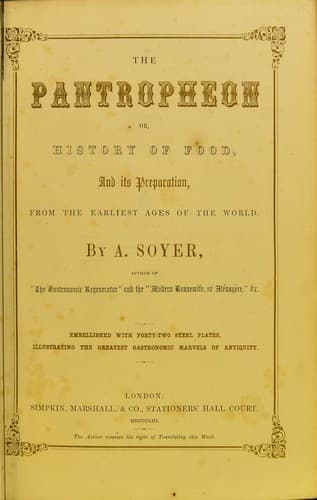
The Pantropheon; Or, History of Food, Its Preparation, from the Earliest Ages of the WorldSoyer, Alexis
History
The Pantropheon; Or, History of Food, Its Preparation, from the Earliest Ages of the World
Soyer, Alexis
Cooking; Food; Gastronomy
This bird, called by the ancients the “Hen of Numidia,” comes originally
from many burning regions of Africa. In Greece, and especially in Rome,
vanity alone gave it a price which was willingly granted, more on
account of its scarcity than for its taste.[XVII-98] The Guinea hen
appeared at great banquets, when the Amphytrion was more anxious to show
his opulence than to demonstrate the delicacy of his dishes.
Martial,[XVII-99] and Pliny,[XVII-100] the naturalist, raised great
objections against this ostentatious and useless rarity.
_Guinea Hen à la Numide._--Cook it; then put it in a saucepan with some
honey and garum; make several incisions in the bird; baste it with its
own gravy, and sprinkle with pepper previously to its being
served.[XVII-101]
THE TURKEY HEN.
“There must be two to eat a truffled turkey,” said a gastronomist of the
18th century, to one of his friends--a noted _gourmand_--who had just
come to pay him a visit. “Two!” replied the visitor, with a smile of
sensuality. “Yes, two,” answered the first; “I never do otherwise: for
instance, I have a turkey to-day, and of course we must be two.” The
friend, looking earnestly at the other, said: “You, and who else?”
“Why,” answered the gastronomist, “I and the turkey.”
In Greece, more than one stomach would have been capable of challenging
nobly the voracity of this modern polyphagus: witness the insatiable
greediness of the well-known glutton who complained that nature ought to
have given him a neck as long as the stork, that he might enjoy for a
longer period his eating and drinking.[XVII-102]
But for a long time the Greeks were quite ignorant of the culinary value
of the turkey; it was looked upon as an uncommon curiosity, and not
condemned to the spit. Sophocles, the first who spoke of it, pretended
that those marvellous birds came purposely from some distant climate
beyond the Indies, to bewail the death of Meleager, who took possession
of the throne of Macedonia (279 years B.C.), and who was soon driven
from it.[XVII-103] This Prince, it is reported, carried them away from
barbarous regions, that they might enjoy the charms of Greek
civilization; and hence could there be anything more natural than to
find those compassionate volatiles shedding tears for their benefactor,
in one of Sophocles’ tragedies? They have been called since,
Meleagrides, and this name perpetuated “misfortune, favour, and
gratitude.”
Aristotle hardly supplies us with any details upon turkey hens: he
merely says that their eggs are distinguished by little specks from
those of the common hens, which are white;[XVII-104] but Clytus of
Miletus, his disciple, gives an exact description of them, by which no
mistake can be made.[XVII-105]
Public-domain text, read in full here on John Shaqi.
Reviews
Reviews
No reviews yet
Be the first to share your thoughts on this work.
Elsewhere in the archive
Join the Discussion
Join the discussion
Sign in to leave a comment or review.
Sign InorCreate an account