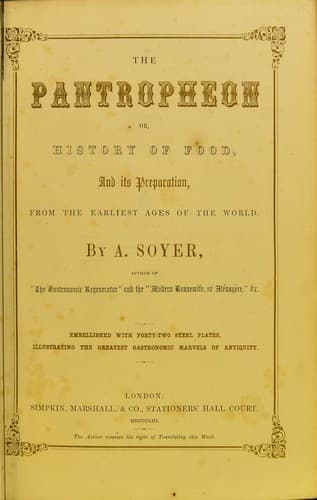
The Pantropheon; Or, History of Food, Its Preparation, from the Earliest Ages of the WorldSoyer, Alexis
History
The Pantropheon; Or, History of Food, Its Preparation, from the Earliest Ages of the World
Soyer, Alexis
Cooking; Food; Gastronomy
The ancients also took game by means of pits covered over with
brushwood, in snares,[XIX-28] with traps,[XIX-29] and with nets;[XIX-30]
moreover, they often made use of bows and arrows, and understood the art
of training falcons and hawks.[XIX-31]
Eastern princes amused themselves by hunting in parks where a great
number of wild beasts were kept.[XIX-32] The Romans had too much taste
and money, and too great a desire to spend it, not to imitate this
expensive and royal luxury. Fulvius Hirpinus possessed a park of forty
acres near Viterbo, in Tuscany. Lucius Lucullus, and Quintus Hortensius
hastened to create more beautiful ones, and they did not fail to have a
host of imitators.[XIX-33]
By the Roman law, hunting was unrestricted:[XIX-34] only, no person
could pursue game on another’s land without the owner’s
permission.[XIX-35]
Besides the pleasure which this amusement afforded, the ancients, like
ourselves, discovered profit in it; and the produce of their chase
became one of the finest ornaments of their feasts. Isaac ordered his
son Esau to go out with his weapons, his quiver and bow, and to prepare
for him savoury meat, such as he loved (venison).[XIX-36] Solomon had
stags, roebucks, and wild oxen served on his table every day.[XIX-37]
Cyrus, King of Persia, ordered that venison should never be wanting at
his repasts.[XIX-38] Is it necessary to add that it was the delight of
two nations the most gastronomic in the world?--of the effeminate
Greeks, and more especially those Romans for whom the animals of the
earth, ocean, and air were only to be valued in proportion to the
impossibility of obtaining them in Europe, Asia, and Africa; an immense
inheritance, conquered by noble ancestors, and which their degenerated
sons ransacked for their satisfaction and insatiable gluttony.[XIX-39]
The English have always loved hunting--the favourite pastime of their
kings.
Alfred the Great was not twelve years old when he had acquired the
reputation of being a skilful and indefatigable hunter.[XIX-40]
The noble and the wealthy differed from the serfs by their singular
taste for this royal diversion; and, in their pursuit of it, they spared
neither pains nor expense in procuring those famous dogs of pure race
which the ancient Greeks and Romans prized so highly. When Athelstan,
Alfred’s grandson, had subdued Constantine King of Wales, he imposed an
annual tribute. The vanquished monarch had to give him gold, silver,
cattle, and, which is remarkable, a certain number of hawks, and dogs
possessing a quick scent, and capable of unkenneling wild
beasts.[XIX-41] Edgar, the successor of Athelstan, changed the tribute
of money into an annual tribute of three hundred wolves’ skins.[XIX-42]
Notwithstanding his great piety, and the extreme reserve of his habits,
Edward the Confessor took great delight in following the hounds, and
exciting their ardour by his cries.[XIX-43]
Public-domain text, read in full here on John Shaqi.
Reviews
Reviews
No reviews yet
Be the first to share your thoughts on this work.
Elsewhere in the archive
Join the Discussion
Join the discussion
Sign in to leave a comment or review.
Sign InorCreate an account