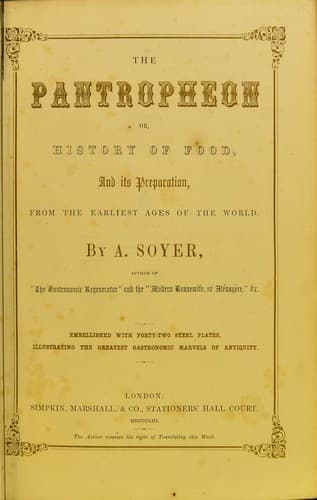
The Pantropheon; Or, History of Food, Its Preparation, from the Earliest Ages of the WorldSoyer, Alexis
History
The Pantropheon; Or, History of Food, Its Preparation, from the Earliest Ages of the World
Soyer, Alexis
Cooking; Food; Gastronomy
King Harold never appeared anywhere without his favourite hawk on his
hand; neither was the approach of the British Nimrod announced otherwise
than by the joyous barking of the royal pack.[XIX-44] Indeed, at that
epoch, every person of distinction took the prince as his model, and
gave himself up, heart and soul, to what people are pleased to call “the
noble exercise of hunting.”
This aristocratic taste became so extremely prevalent under the
domination of the Norman kings, that a writer of the twelfth century has
judged it with great severity. “In our time,” he says, “hunting is
considered as the most honourable occupation, the most excellent virtue.
Our nobility show more solicitude, sacrifice more money, and make a
greater parade in favour of it, than they would if the question were
war. They are more furious in the pursuit of wild beasts, than they
would be if they had to conquer the enemies of Great Britain. As a
necessary consequence, they no longer retain any sentiment of humanity;
they have descended almost to the level of the savage animals they are
in the daily habit of tracking and unkenneling.”[XIX-45]
These uncomplimentary observations of John of Salisbury did not prevent
James I. from pursuing the cherished diversion of his predecessors. That
prince being one day at the hunt in the environs of Bury St. Edmunds,
remarked, among the persons composing his suite, an opulent citizen
magnificently dressed, whose rich costume eclipsed that of the lords the
most renowned at court for the elegance of their attire. The king asked
who the hunter was. Some one replied that it was Lamb. “Lamb, say you?”
rejoined the king, laughing; “I don’t know what sort of a lamb that may
be; but what I know well is, that he has got a superb fleece on his
back.”[XIX-46]
THE STAG.
Roman ladies of the highest distinction, arrived at that age when, in
making an estimate of life, it is found that the largest portion belongs
to the past--these ladies, we say, failed not to have the flesh of this
animal served on their tables, and to eat as much of it as possible.
Perchance it had but a slight attraction for the worthy matrons, and yet
they preferred it to every other, for this reason, that the stag being
free from maladies and infirmities--at least so it was
thought--prolongs its existence far beyond the bounds which nature has
assigned to other beings.[XIX-47] The noble patrician ladies would not
have been sorry to survive their great-grandchildren, and they took the
means which appeared to them most likely to ensure longevity.[XIX-48]
If the celebrated Galen had lived in their time, he would have told
those credulous Roman ladies, that this kind of food could not fail to
be hurtful to them; that this indigestible and heating meat is more
likely to provoke disease than to destroy its germ; and that,
consequently, death finds in it an auxiliary rather than an
enemy.[XIX-49]
Public-domain text, read in full here on John Shaqi.
Reviews
Reviews
No reviews yet
Be the first to share your thoughts on this work.
Elsewhere in the archive
Join the Discussion
Join the discussion
Sign in to leave a comment or review.
Sign InorCreate an account