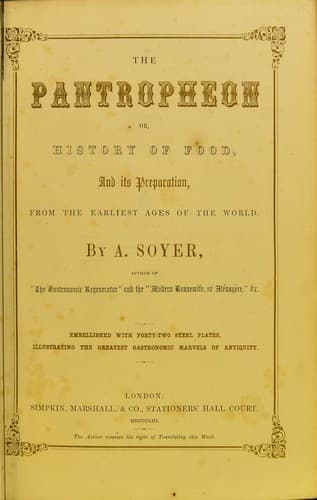
The Pantropheon; Or, History of Food, Its Preparation, from the Earliest Ages of the WorldSoyer, Alexis
History
The Pantropheon; Or, History of Food, Its Preparation, from the Earliest Ages of the World
Soyer, Alexis
Cooking; Food; Gastronomy
True, the oracle of Pergama wrote nearly all this a century later, and
yet his medical authority was powerless to persuade, although it may
have convinced the obstinate epicureans of his period.
In point of fact, whatever Galen may say, what dreadful accidents can a
piece of stag properly cooked produce? Moses, so attentive to the health
of his people, allows them the use of it;[XIX-50] Solomon, the wisest of
men, ate it every day.[XIX-51] Do we find that the Jewish monarch and
his people were any the worse for preferring this food?
At Athens, at Rome, and in all Italy, whoever possessed the intelligence
of appreciating good cheer, took care to offer to his friends the
shoulder or fillet of stag.[XIX-52] Nevertheless, gastronomists by
profession, who so generously devoted their fortunes to the service of
the culinary art, abandoned the whole animal to their slaves, and only
reserved for themselves the most tender shoots of the horns. These were
for a long time boiled, then cut into very small pieces, and this
strange dish, seasoned with a mixture of pepper, cummin, savory, rue,
parsley, bay leaves, fat, and pine nuts, sprinkled with vinegar, and
fried, passed for an exquisite and dainty treat, worthy of the most
flattering praises.[XIX-53]
_Quarter of Stag, roast à la Neméenne._--Put into a saucepan pepper,
alisander, carrots, wild marjoram, parsley seed, benzoin root, and
fennel seed; add garum, wine, cooked wine, and a little oil. Boil over a
slow fire, thicken with fine flour, pour on the roast stag, and
serve.[XIX-54]
_Shoulder of Stag à l’Hortensius._--Cook in a saucepan carrots,
alisander, with pepper and parsley seed. Add honey, garum, vinegar, and
luke-warm oil; thicken with fine flour, and pour this sauce on the
shoulder of stag when roasted.[XIX-55]
_Fillet of Stag à la Persane._--Roast it, and at the moment of placing
it on the table, cover it with a seasoning of pepper, alisander,
scallions, wild marjoram, onions, and pine nuts, previously mixed with
honey, garum, mustard, vinegar, and oil.[XIX-56]
THE ROEBUCK.
The flesh of the roebuck, according to Galen, has none of the bad
qualities which he attributes to that of the stag.[XIX-57] Esculapius
and Comus for this once agreed--which very seldom happened--in praising
the beneficial properties and the delicious odour of these timid
quadrupeds.
The Greeks thought much of the roebuck; they obtained the best from the
island of Melos,[XIX-58] and served them at their most sumptuous
repasts.[XIX-59] They were, perhaps, more rarely seen on Roman tables.
_Roebuck with Spikenard._--Pound, in a mortar, pepper, parsley seed, dry
onion, and green rue; add spikenard, and then honey, vinegar, garum,
dates, cooked wine, and oil; mix well the whole, and cover the roast
with it.[XIX-60]
Public-domain text, read in full here on John Shaqi.
Reviews
Reviews
No reviews yet
Be the first to share your thoughts on this work.
Elsewhere in the archive
Join the Discussion
Join the discussion
Sign in to leave a comment or review.
Sign InorCreate an account