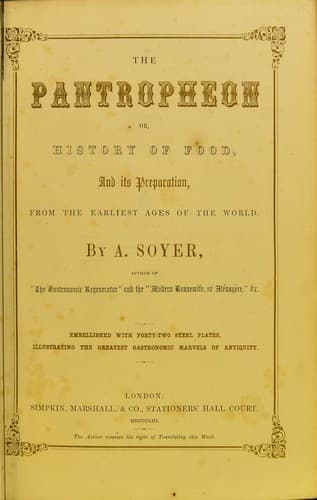
The Pantropheon; Or, History of Food, Its Preparation, from the Earliest Ages of the WorldSoyer, Alexis
History
The Pantropheon; Or, History of Food, Its Preparation, from the Earliest Ages of the World
Soyer, Alexis
Cooking; Food; Gastronomy
This charming little animal, which ought never to please but when alive,
often appeared at Rome among the most elegant dishes of the
feast.[XIX-111] At first it was only eaten by caprice: unfortunately for
the little animal, it was found to be very nice.
THE CAMEL.
Aristotle gives the greatest praise to the flesh of this useful animal,
and places it without hesitation above the most delicate
viands.[XIX-112] The Greeks, his countrymen, thought it worthy of being
roasted for the table of sovereigns,[XIX-113] and the inhabitants of
Persia and Egypt partook of the same enthusiasm. Rome thought the camel
fit for the solitude of the Desert, but not for the ornament of
banquets; and really, for this once, Rome appears to have been right.
“The flesh of the young dromedary is as good as that of veal, and the
Arabs make of it their common food. They preserve it in vases, which
they cover with fat. They make butter and cheese with the milk of the
female.”--DESMAREST.
The ancients, in their wars, made use of dromedaries. The soldiers when
upon these animals formed a particular militia. In the Egyptian
expedition Bonaparte renewed this ancient custom, and that cavalry
caused a great deal of injury to the Bedouins and Arabs. Besides the
rider, each dromedary carried provisions and munitions of war.
THE ELEPHANT.
Certain wandering tribes of Asia and Africa were thought formerly to be
very fond of grilled elephant.[XIX-114] The Egyptians went so far in
their pursuit of this delicacy, that the King Ptolemy Philadelphus was
forced to forbid them, under pain of the most severe laws, to kill one
of these animals, whose number diminished every day. The law was
disregarded, and the elephant only possessed greater attractions for
them.[XIX-115]
In our days, also, some semi-savage nations partake of the same taste.
Le Vaillant, a celebrated traveller, and a most distinguished
gastronomist, tells us that the first time he partook of an elephant’s
trunk, which was served him by the Hottentots, he resolved that it
should not be the last; for nothing appeared to him of a more exquisite
flavour.[XIX-116] But he reserves his greatest praises for the foot of
the colossal quadruped. We will let him speak for himself:--
Public-domain text, read in full here on John Shaqi.
Reviews
Reviews
No reviews yet
Be the first to share your thoughts on this work.
Elsewhere in the archive
Join the Discussion
Join the discussion
Sign in to leave a comment or review.
Sign InorCreate an account