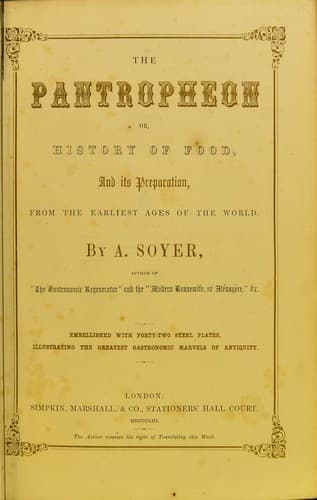
The Pantropheon; Or, History of Food, Its Preparation, from the Earliest Ages of the WorldSoyer, Alexis
History
The Pantropheon; Or, History of Food, Its Preparation, from the Earliest Ages of the World
Soyer, Alexis
Cooking; Food; Gastronomy
A profound study of the art of good cheer caused the Romans to discover
that the thick tongue of the phenicopter, or flamingo, presents towards
its root a rather considerable adipose appendage. They tasted this lump
of fat, and Rome was enriched with another dish.
It has been asserted that the glory of inventing this refinement in
gluttony is due to Apicius. Italy possessed three gastrophiles of this
name: the first flourished a short time before the dictatorship of
Julius Cæsar; the second, Marcus Gabius, held a school of sensuality at
Rome, under the reigns of Augustus and Tiberius; the third, Cælius, was
contemporary with Trajan, and poisoned himself for fear of dying of
hunger.
We possess, under the name of this last, a Latin work in ten books, from
which we have borrowed largely, as the reader may have already remarked.
It would be difficult to decide to which of the three Apicii it belongs.
The author speaks of the flamingo, but does not mention its tongue: the
treatise, then, is not the work of M. Gabius, who would doubtless have
indicated the preparation of a dish of which Pliny assures us he was so
fond.[XX-64] As to Cælius, if he were the compiler of this
[Illustration: _Pl. 10_]
curious volume, as it is thought, how comes it he has forgotten a dish
so justly celebrated, in this magiric catalogue, in which no detail,
however minute, seems to escape him? It would appear that this contested
paternity rightfully belongs to the first Apicius, unless some of the
learned contest it on the ground that the style of the work nowise
agrees with the latinity of his century.[XX-65]
May one of the learned societies of Europe some day take up this arduous
question, and restore the ancient masterpiece to its admirable author.
In the meantime the writer of the present work will continue to venerate
the memory of Cælius Apicius, and offer him crowns of smallage, roses,
and parsley, for his name embellishes the frontispiece of those pages
which reveal to us the secrets of Roman cookery; and we repeat, with
Sosie:--
“Le véritable Amphitryon
Est l’Amphitryon où l’on dine.”[XX-66]
Honour is due also to the other Apicius for his ingenious sauce of
flamingo tongues. True, we have never tasted it, for this expensive
fancy can only be satisfied in the marshes of the Nile.[XX-67] It is
still little known in Europe, but the most fastidious of the Romans
regaled themselves with it.[XX-68] Three Emperors, Caligula, Vitellius,
and Heliogabalus--immortal triumvirate of incomparable
polyphagists!--carried to indigestion their gastronomic delirium, their
love for this famous _ragoût_.[XX-69] These great authorities are
conclusive.
The traveller, Dampier, wished to try the flesh of the flamingo, and he
thought it very good, though lean, and very black.[XX-70]
Public-domain text, read in full here on John Shaqi.
Reviews
Reviews
No reviews yet
Be the first to share your thoughts on this work.
Elsewhere in the archive
Join the Discussion
Join the discussion
Sign in to leave a comment or review.
Sign InorCreate an account