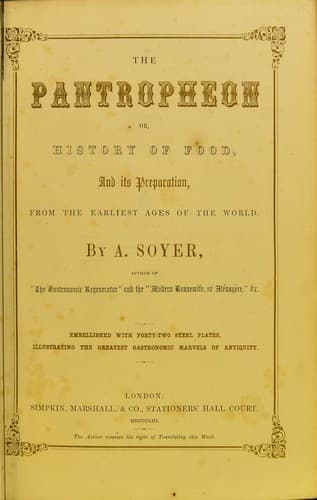
The Pantropheon; Or, History of Food, Its Preparation, from the Earliest Ages of the WorldSoyer, Alexis
History
The Pantropheon; Or, History of Food, Its Preparation, from the Earliest Ages of the World
Soyer, Alexis
Cooking; Food; Gastronomy
“The flesh of the phenicopterus is a dish more sought after in Egypt
than in Europe; however, Catesby compares it for its delicacy to the
partridge; Dampier says it has a fine flavour, although lean; Dutertre
finds it excellent notwithstanding its marshy taste; the tongue is the
most delicious part.”--VIEILLOT.
FIG-PECKER, OR, BECAFICO.
The Duke of C---- had received from nature one of those culinary
organizations which the vulgar assimilate with gluttony, and the man of
art calls genius. Greece would have raised statues to him; the Roman
emperor Vitellius would have shared the Empire with him. In France he
gained the esteem of all parties by inviting them to sumptuous banquets.
This rich patrician brought up with tender care a young _chef de
cuisine_, whom his _major-domo_ had bequeathed to him on his death-bed,
as Mazarin did Colbert to Louis XIV. The disciple profited by the
learned lessons of the Duke; already the young _chef’s_ head, eye, and
hand possessed that promptitude and certainty whose union is so rarely
combined: there remained for him only the instruction of experience.
One day, in the month of September, some guests of the highest class,
all professed judges in the order of epicureans, met together at the
residence of the noble Amphitryon, who often claimed the authority of
their enlightened judgment. The learned Areopagitæ had to pronounce on
certain new dishes: it was necessary, by dint of seduction, to captivate
the favour and patronage of these judges by disarming their severity.
Everything was served to the greatest nicety, everything was deemed
exquisite, and they only awaited the dessert--that little course which
causes the emotion of the great culinary drama to be forgotten--when the
young _chef_ appeared, and placed in the centre of the table a silver
dish, containing twelve eggs. “Eggs!” exclaimed the Duke. The astonished
guests looked at each other in silence. The cook took one of the eggs,
placed it in a little china boat, slightly broke the shell, and begged
his master to taste the contents. The latter continued to remove the
white envelope, and at length discovered a savoury and perfumed ball of
fat. It was a fig-pecker of a golden colour--fat, delicate,
exquisite--surrounded by a wonderful seasoning.[XX-71]
The good old man cast on his pupil a look full of tenderness and pride;
and, holding out his hand to him: “You are inspired by Petronius,” said
he; “to imitate in such a manner is to create. Courage! I am much
pleased with you.”
This classic dish--a revival from the feasts of Trimalcio--enjoyed only
an ephemeral glory. Europe was on fire; a warlike fever raged
everywhere; and Paris soon forgot the eggs of Petronius.
The fig-pecker merits the attention of the most serious gastronomists.
The ancients reckoned it among the most refined of dishes.[XX-72] The
Greeks made delicate pies of this bird, which exhaled an odour so
tempting, that criticism was disarmed beforehand.[XX-73]
Public-domain text, read in full here on John Shaqi.
Reviews
Reviews
No reviews yet
Be the first to share your thoughts on this work.
Elsewhere in the archive
Join the Discussion
Join the discussion
Sign in to leave a comment or review.
Sign InorCreate an account