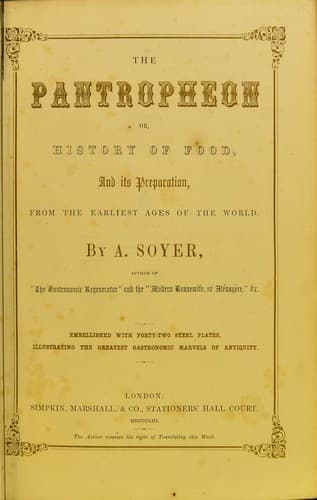
The Pantropheon; Or, History of Food, Its Preparation, from the Earliest Ages of the WorldSoyer, Alexis
History
The Pantropheon; Or, History of Food, Its Preparation, from the Earliest Ages of the World
Soyer, Alexis
Cooking; Food; Gastronomy
The Romans gave it their entire esteem,[XX-74] and prepared it with
truffles and mushrooms.[XX-75] Among them, men who knew what good cheer
means, thought there was nothing worth eating in birds but the leg and
lower part of the body. Fig-peckers were the only exception to this
rule: they were served and eaten entire.
“In the southerly parts of France, and in Italy, all the different
species of linget, and almost all birds with a slender beak, are
commonly called becafico, because in the autumn they attack and eat the
figs, and thereby the flesh of these birds becomes then fat and
exquisite; but that really known as the becafico is remarkable for its
delicacy; therefore it has at all times been _recherché_ as an excellent
eating. It is like a small lump of light fat--savoury, melting, easy of
digestion; and, in truth, an extract of the juice from the delicious
fruits it has fed upon.”--_Vieillot._
THE ORTOLAN.
Florence and Bologna sent to Rome cases of ortolans, the enormous price
of which irritated instead of discouraging gluttony.[XX-76] They arrived
in the metropolis of the world, picked and separated one from the other
by layers of flour to prevent decomposition.[XX-77] Each of these little
birds furnished only a mouthful; but this incomparable mouthful eclipsed
everything else, and produced a sort of epicurean extacy which may be
called the _transcendantalism_ of gastronomy.
Ortolans were submitted to the same treatment as fig-peckers in their
preparation.
THE OSTRICH.
There were tribes formerly in Arabia who fed on ostriches, and who for
this reason were called strutiophagists.[XX-78] Marmot asserts that, in
his time, they were eaten in Africa, although their flesh was glutinous,
and had a bad smell. When the people of Numidia took any that were
young, they reared and fatted them, and led them to feed by flocks in
the Desert; and as soon as they were fat they killed and salted
them.[XX-79]
The Arabs of the present day abstain from them; but it is said they seek
much the fat, which they use plentifully in cooking.
They were served at Rome on a few tables. This was nothing but a
depravation of taste.
Heliogabalus, who understood good living better, contented himself with
the brains of ostriches. Six hundred of these animals furnished enough
for one meal.[XX-80] The devastation was great, but the emperor had made
a good supper.
The ostrich’s eggs are very hard, very heavy, and very large; their
weight often equals three pounds. The colour is of a dirty white, with
light yellow veins; they are good to eat. In Africa they are sought
after as a _friandise_, and cooked in various ways. The commonest and
the best is, after breaking, to mix and cook them with a good deal of
butter. They are large enough and sufficient for a man’s meal.
Public-domain text, read in full here on John Shaqi.
Reviews
Reviews
No reviews yet
Be the first to share your thoughts on this work.
Elsewhere in the archive
Join the Discussion
Join the discussion
Sign in to leave a comment or review.
Sign InorCreate an account