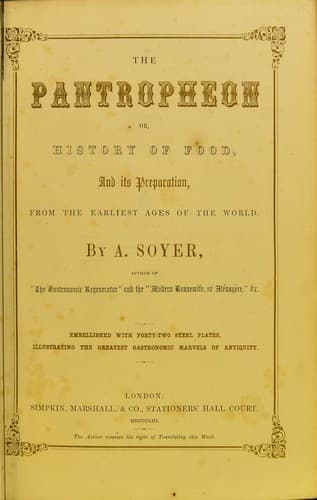
The Pantropheon; Or, History of Food, Its Preparation, from the Earliest Ages of the WorldSoyer, Alexis
History
The Pantropheon; Or, History of Food, Its Preparation, from the Earliest Ages of the World
Soyer, Alexis
Cooking; Food; Gastronomy
When the Arabs have killed an ostrich they open its throat, and make a
ligature under the opening; three or four men take the bird, and shake
it, the same as rincing a pouch; after which, the ligature being undone,
a considerable quantity of a greasy substance comes out, mixed with
blood and fat as thick as coagulated oil. One ostrich produces as much
as twenty pounds of it, and it is used for the preparation of dishes,
for the cure of rheumatism, _humeurs froides_, and paralysis. The Romans
used this grease for the same purposes, and believed it possessed the
most precious qualities.
THE STORK.
In spite of the religious respect of the Romans for this bird, the
emblem of peace[XX-81] and domestic virtues, Sempronius Rufus, an
ancient prætor, caused his cook to dress some young storks; and this
brought into fashion[XX-82] a dish which caprice alone could introduce
at feasts.[XX-83]
THE SEA-SWALLOW.
Among the ancients, the swallow--joyous herald of spring--possessed
little attraction for those men whom their gluttony has rendered so
justly celebrated. Alas! they knew not the “Salangan swallow,” _hirundo
esculenta_; they never tasted those birds’ nests which Europe still
envies the East.
The inhabitants of the Philippine Islands give the designation of
salangan swallow to a little coast bird (the halcyon, or kingfisher),
celebrated for the singular construction of its nest. These nests have
been compared to those which the Greeks and Romans called halcyon’s
nests; but this comparison is false, since the marine productions to
which they gave this name are not birds’ nests but polypus’s, or the
cylindrical covering of the polypi--the _halcyonium_--a kind of
medicament, of which there were several varieties.[XX-103]
All travellers agree that the Chinese, and other eastern nations, have
an extreme partiality for the salangan’s nest, as a delicious seasoning
for their viands, and that they value it excessively; but they differ
strangely as to its nature, its form, and the places where it is found.
According to some, the material of these nests is a froth of the sea, or
the spawn of fish, and strongly aromatic. Others say it has no taste.
Some pretend that it is a juice gathered by the salangans from the tree
called _salambouc_; some maintain that it is a viscous humour that they
give out from the beak at a certain period of the year; and, lastly,
many affirm that these birds compose it entirely from the remains of
fish-zoophytes.
With respect to the form, some say that it is hemispherical; others that
it resembles a shell valve.
As to the places where the salangans build their nests, some observers
assure us that it is fixed on the rocks a little above the level of the
sea; in the hollows of those same rocks; and, lastly, that they conceal
them in holes which they burrow under ground. According to Kœmpfer,
these nests, so far as they are known to us, are nothing more than a
preparation concocted from the flesh of the polypi.
Public-domain text, read in full here on John Shaqi.
Reviews
Reviews
No reviews yet
Be the first to share your thoughts on this work.
Elsewhere in the archive
Join the Discussion
Join the discussion
Sign in to leave a comment or review.
Sign InorCreate an account