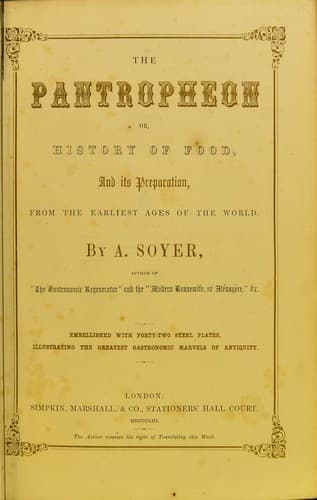
The Pantropheon; Or, History of Food, Its Preparation, from the Earliest Ages of the WorldSoyer, Alexis
History
The Pantropheon; Or, History of Food, Its Preparation, from the Earliest Ages of the World
Soyer, Alexis
Cooking; Food; Gastronomy
The celebrated traveller Poivre, while occupied one day in picking up
shells and coral near Java, penetrated a rather deep cavern at a short
distance from the sea shore, and found the sides of it covered with
little nests, in the form of a deep shell, firmly fixed to the rock.
These nests were taken on board, and several persons who had been in
China immediately recognised them as being identical with those that the
Chinese seek with such avidity. The birds which had built them were true
swallows, of about the size of the humming bird. Poivre adds that, in
the months of March and April, the sea from Java to Cochin China is
covered with spawn, which has the appearance of half-dissolved glue, and
that he had learned from the Malays and the Cochin Chinese that the
salangan builds its nest with this spawn. All agreed on this point. The
bird picks it up as he skims the water, or from the rocks where the
spawn coagulates. It is at the end of July and the commencement of
August that the Cochin Chinese collect the nests, and, as the young
birds are hatched in March and April, the species do not suffer by it.
By the subsequent examination of these nests it was found that they
presented the form of the half of a hollow, lengthened ellipsoid. They
are composed, externally, of very thin laminæ, nearly concentric, and
laid one over the other. The interior presents several layers of
irregular net-work, superposed one over another, and formed of a
multitude of threads of the same matter as the external laminæ, and
which cross and re-cross in every direction.
Their composition, which has a slight taste of salt, is of a yellowish
white and demi-transparent; it softens in warm water without dissolving,
and increases in volume. It is a substantial food, and would be
excellent for persons suffering from exhaustion, whose debile stomachs
ill perform their functions. Poivre declares that he never eat anything
more fortifying than a pottage made with these nests and some good meat.
The salangan nests are of two sorts--the white and the black. It appears
that the white nests are those of the same year, and that the black ones
belong to an epoch less recent. The birds are engaged about two months
in preparing them, and the Chinese do not take them away until the young
ones are feathered, and begin to be pretty strong on the wing.[XX-104]
* * * * *
This nomenclature would be incomplete, did we not briefly mention some
kinds of game which appeared with more or less favour on the tables of
the ancients.
The _Wood-Hen_, dear to the Greeks,[XX-84] was not common at Rome in the
time of Varro. The curious reared them in aviaries with other rare
birds.[XX-85]
The _Bustard_, the _Water-Hen_, and the _Teal_, found many
admirers.[XX-86] The Romans reared the last-named,[XX-87] and judged it
worthy of notice among the most delicate morsels of the feast.
Public-domain text, read in full here on John Shaqi.
Reviews
Reviews
No reviews yet
Be the first to share your thoughts on this work.
Elsewhere in the archive
Join the Discussion
Join the discussion
Sign in to leave a comment or review.
Sign InorCreate an account