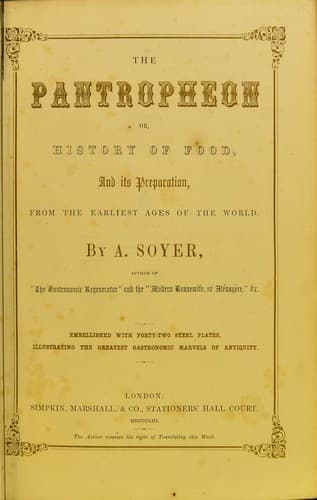
The Pantropheon; Or, History of Food, Its Preparation, from the Earliest Ages of the WorldSoyer, Alexis
History
The Pantropheon; Or, History of Food, Its Preparation, from the Earliest Ages of the World
Soyer, Alexis
Cooking; Food; Gastronomy
The rhombo claimed the attention of the discriminating ichthyophagists
of Rome by the delicacy of its flesh, and few fish would have been
preferred to it had it not been feared that it rendered digestion
difficult.[XXI-181] Some intrepid stomachs, however, greeted this dish
without much repugnance when presented to them fried and sprinkled with
pepper, in the midst of a seasoning in which pepper, cummin, coriander,
benzoin, wild marjoram, and rue, heightened by a little vinegar, were
mixed with dates, honey, cooked wine, and oil. This boiling sauce was
poured over the rhombo, but not before it had been enriched with
garum,[XXI-182] which we had almost forgotten--that inevitable brine
which the ancient magiric genius placed everywhere, and whose prodigious
renown ought to have preserved it from oblivion.
MUGIL.
This fish, singular instrument of a punishment invented by
Rome,[XXI-183] entered into the bill of fare of a fashionable supper,
but one without that magnificence which a feast of parade exacts. It was
prepared with pepper, alisander, cummin, onion, mint, rue, sage, and
dates, mixed with honey, vinegar, mustard, and oil.[XXI-184]
The Greeks also esteemed mugils, and gave a preference to those sold by
the fishermen of Scyathus.[XXI-185]
MACKEREL.
Commentators do not agree on the origin of this word. Scaliger, who
perceived Greek in everything, says it is derived from _makarios_,
“happy.” But, then, in what does the felicity of this fish consist? The
old writer Belon, more wise in his conjecture, thinks this word comes
from the Latin, _macularelli_, “little spots,” because it is marked on
the back with black stripes.[XXI-186]
Let the etymology be what it may, the epicurean cares very little about
it. Mackerel was much liked in Greece, where it was believed to be a
native of the Hellespont;[XXI-187] and throughout Italy, where it was
supposed to come originally from Spain.[XXI-188]
It is very probable that from mackerel was obtained one of the varieties
of garum, known by the name of _garum sociorum_. Further on, we intend
to devote a special chapter to the subject of this celebrated condiment.
“Neither the size nor the weapons of mackerel make them formidable; they
have, however, a violent appetite, and on account, perhaps, of the
confidence they feel in the number of each shoal, they are bold and
voracious, frequently attack fishes larger and stronger than themselves,
and even dart with blind audacity upon the fishermen who bathe where
they happen to be. Thus Pontoppidan relates that a sailor, bathing in
the port of Carcule, in Norway, missing one of his companions, saw him a
few minutes afterwards dead, the body mangled and covered with a
multitude of mackerel, tearing his remains to pieces.”--DR. CLOQUET.
HADDOCK.
Public-domain text, read in full here on John Shaqi.
Reviews
Reviews
No reviews yet
Be the first to share your thoughts on this work.
Elsewhere in the archive
Join the Discussion
Join the discussion
Sign in to leave a comment or review.
Sign InorCreate an account