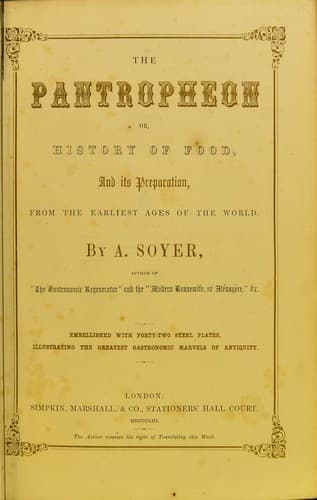
The Pantropheon; Or, History of Food, Its Preparation, from the Earliest Ages of the WorldSoyer, Alexis
History
The Pantropheon; Or, History of Food, Its Preparation, from the Earliest Ages of the World
Soyer, Alexis
Cooking; Food; Gastronomy
Such is, to use an original expression of Rabelais, “_toute l’artillerie
de gueule_,” which the cook can master. It is the sum total of what has
been bequeathed to us by some great men, whose scattered instructions,
lying here and there in books of morality and philosophy--there are
numerous analogies between the act of eating and the art of living
well--have been collected with scrupulous care, classed with all the
attention we can command, and will serve, we hope, to beguile the
studious leisure of the lovers of antiquity and the culinary science.
Mankind had long obeyed that imperious and periodical necessity which
has been called hunger, when it announces its presence with its brutal
exigencies, before any one thought to form a code of doctrine calculated
to guide a sensation which, by its energy and duration, procures us the
most thrilling and lasting pleasures.
The primitive nations no doubt gave themselves up to their native
gluttony. They eat much, but they fed badly. They did not yet possess
gastronomy; and, consequently, they had no cooks, in the serious and
complete acceptation of the word.
The heroes of Homer prepared their repasts with their own hands,--and
what repasts, gods of taste!--and prided themselves on their culinary
talents. _Où la vanité va-t-elle se nicher?_ Ulysses surpassed all
others in the art of lighting the fire, and laying the cloth.[XXII-8]
Patroclus drew the wine, and Achilles very carefully turned the
spit.[XXII-9]
The conquerors of Troy shone more in the combat than under the tent
which served them as kitchen.
At length the aurora of the magiric ages began to dawn: it is not a
revolution, it is a creation which is preparing to appear. Man has only
known hunger; he shall now become acquainted with the charms of an
appetite. The King of Sidon learns how to eat, and it is Cadmus, the
grandfather of Bacchus, the future founder of Thebes, who takes upon
himself to instruct this august mouth.[XXII-10]
And since that time how many illustrious followers have descended into
the arena, how many glorious names will not culinary annals have to
register!
Somebody will, perhaps, one day publish a chronological history of
celebrated cooks. In the meantime, it may not be amiss to recall to
memory a few illustrious men, whose services and genius an ungrateful
posterity has too soon forgotten.
Thimbron, among the Greeks, took the culinary art from its cradle: he
watched devoutedly over its development, and only descended into the
tomb after having won the heart of the whole of Greece,[XXII-11] for his
favourite science. Timachidas of Rhodes, cook and poet of the highest
renown, composed an epopee on the art which he professed, in the midst
of emanations from the stoves and the spit.[XXII-12] His verses, glowing
with the sacred fire which inspired him, lighted up the magiric vein of
several of his disciples, among whom Numenius, Hegemon, and Metreas, are
still cited.[XXII-13]
Public-domain text, read in full here on John Shaqi.
Reviews
Reviews
No reviews yet
Be the first to share your thoughts on this work.
Elsewhere in the archive
Join the Discussion
Join the discussion
Sign in to leave a comment or review.
Sign InorCreate an account