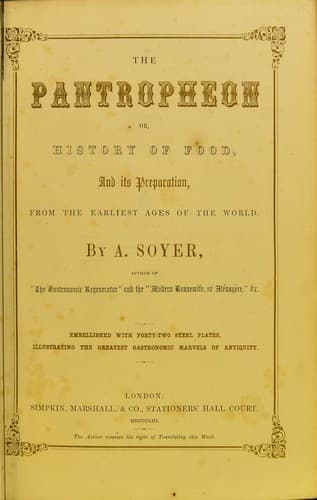
The Pantropheon; Or, History of Food, Its Preparation, from the Earliest Ages of the WorldSoyer, Alexis
History
The Pantropheon; Or, History of Food, Its Preparation, from the Earliest Ages of the World
Soyer, Alexis
Cooking; Food; Gastronomy
Artemidorus collected and commented on all the words in use in the
kitchens of his time.[XXII-14] Greece owed to this patient terminologist
the possession of a culinary language, subject to certain unchangeable
rules.
Mithœcus gave the “Sicilian Cook”--a remarkable type of a multitude
of tiresome and insipid imitations.[XXII-15]
At length Archestratus appeared. He was of Syracuse, and passed all his
life in profoundly meditating on the functions, strength, anomalies, and
resources of the stomach. He discovered the laws which govern that
organ, and presented to the world his magnificent treatise on
gastronomy[XXII-16]--an inestimable master-piece of laborious
investigation of which time has deprived us, together with the works of
his useful predecessors.
We must not omit the names of some celebrated theoricians, to whom the
art owes its rapid progress:--Philoxenus of Leucadus, devoted himself to
the difficult study of degustation, and practised several experiments,
which were, however, ill-appreciated by his contemporaries. Thus, in the
public baths, he accustomed his mouth and hands to the contact of
boiling-water, in order to be able to seize and devour burning viands,
the instant they were placed on the table. He recommended cooks to serve
everything very hot, so that he alone exercised mastication and
deglutition, while other guests less inured, were obliged to content
themselves with looking at him.[XXII-17]
Pithyllus invented a sheath that covered the tongue, and protected it,
without paralyzing its action, against a caloric dangerous to its
delicate tissue.[XXII-18] This ingenious cuirass was not appreciated,
and history, in its thoughtlessness, has not even transmitted to us a
description of it.
It was then the good time of Athens: gluttons had made way for
epicureans; hunger, to a less fierce and gross sensation, already
subjected to examination and discussion. The magiric art possessed its
rules, its various partisans, its professors, and disciples. Great
masters studied deeply the appetite--indispensable basis, on which will
always rest the culinary exegesis; and they finished by classing it
definitively, according to the three degrees of intensity which
observation discovers in it.
_The bold appetite_, said they, is that which is felt when fasting. It
reflects but very little; is not squeamish about viands, and loses all
reserve at the sight of a very indifferent _ragoût_.
_The indolent appetite_ requires to be encouraged. It must be enticed,
pressed, irritated. At first, nothing moves it--but after having tasted
a succulent dish, it rouses, is astonished, its ardour becomes animated,
and is capable of performing prodigies. It is this appetite which has
consecrated the trivial but true proverb: “_L’appétit vient en
mangeant_.”
Public-domain text, read in full here on John Shaqi.
Reviews
Reviews
No reviews yet
Be the first to share your thoughts on this work.
Elsewhere in the archive
Join the Discussion
Join the discussion
Sign in to leave a comment or review.
Sign InorCreate an account