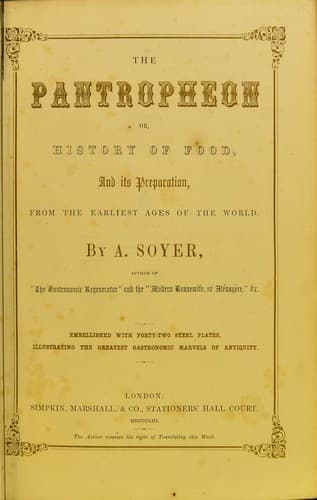
The Pantropheon; Or, History of Food, Its Preparation, from the Earliest Ages of the WorldSoyer, Alexis
History
The Pantropheon; Or, History of Food, Its Preparation, from the Earliest Ages of the World
Soyer, Alexis
Cooking; Food; Gastronomy
The _eclectic appetite_ owes nothing to nature; it is the child of art.
Happy, thrice happy, the skilful cook to whom it says: “Thou art my
father!” But how difficult is this creation--how rare! It is the work of
genius--but listen. Some guests, chosen amidst veteran epicureans, seat
themselves round a table covered with culinary offerings worthy only of
the God of Feasts, and a small number of the faithful. Their _indolent
appetite_ examines, compares, judges, and, at length, abandons itself to
the incomparable dainties from which it unceasingly seems to draw new
ardour. But alas! pleasure, like pain, has its limits here below.
Strength grows less, and becomes extinguished; the eye loses its greedy
covetousness;[XXII-19] the palate languishes; the tongue becomes
paralysed; the stomach sinks, and that which before pleased, now creates
only fatigue and disgust. It is then that a _cusinier hors ligne_, tries
a bold diversion, which must never be risked if the artist does not feel
in himself that force of generous efforts which is no other than genius.
By his orders, three or four dishes, prodigies of science and of luxury,
appear on the altar, which the sacrificers no longer heed. At this
sight, their looks brighten; desire revives; the smile reappears; the
magiric _facies_ shines forth with all its splendour; the chest dilates,
and you no longer distinguish your former guests. A man has transformed
them. Each one chooses, tries, tastes--is silent, and lost in wonder.
The appetite is perhaps tired, but not satiated; and the skilful cook at
length enjoys a deserved triumph.
In this solemn moment he received, among the ancients, a crown of
flowers[XXII-20]--sweet and noble recompense of his arduous toil. Nay, a
more substantial proof of gratitude often greeted his new dishes. In
Greece, the inventor alone had a right to prepare them during a whole
year, and drew from it all the honour and profit. It was necessary, in
order that these culinary preparations should fall into the public
domain, that some one of his colleagues should succeed in surpassing
him.[XXII-21]
At this epoch, the best cooks came from Sicily. Trimalcio was one of the
most celebrated. Athenæus tells us that, when he could not procure rare
and highly esteemed fish, he understood so well how to imitate their
form and flavour with common fish, that the most cunning epicures were
always entrapped. This reminds us of a certain cook of Louis XIV., who,
on Good Friday, served the king with a dinner, apparently composed of
poultry and butcher’s meat, which, in reality, offered nothing but
vegetables, and prepared, too, _au maigre_.
Public-domain text, read in full here on John Shaqi.
Reviews
Reviews
No reviews yet
Be the first to share your thoughts on this work.
Elsewhere in the archive
Join the Discussion
Join the discussion
Sign in to leave a comment or review.
Sign InorCreate an account