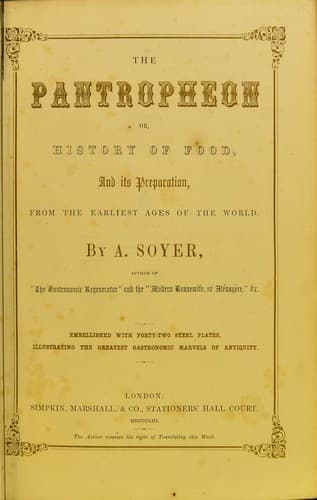
The Pantropheon; Or, History of Food, Its Preparation, from the Earliest Ages of the WorldSoyer, Alexis
History
The Pantropheon; Or, History of Food, Its Preparation, from the Earliest Ages of the World
Soyer, Alexis
Cooking; Food; Gastronomy
Whatever may be the opinion the reader may form of this garum, of which
mention has so frequently been made, and which has been alternately
praised and despised by the moderns, it is certain that the most
fastidious persons were madly fond of it, and that in the time of Pliny,
it was so much esteemed, that its price equalled that of the most
precious perfumes.
“At the present day this celebrated seasoning is forgotten in Italy, but
in Turkey it is still in use. The inn-keepers of Constantinople preserve
in garum the cooked fish not consumed in the day.”--BOSC.
HONEY.
What is sweeter than honey?[XXIII-43] what is more pure,[XXIII-44] or
more nourishing?[XXIII-45] It is the milk of the aged, it prolongs their
existence,[XXIII-46] and when they descend into the tomb, it still
serves to embalm them.[XXIII-47]
Pagan antiquity ascribed the honour of the discovery of this useful
substance to the Athenian Aristæus, who taught mankind to feed on it.
This valuable service procured him a patent of nobility. He was made a
descendant of Bacchus or Apollo.[XXIII-48]
It is not necessary to say that honey was known in the east long before
the rise of Athens; it is already mentioned in the first book of the
holy writings.[XXIII-49]
It is said that Spain owed its knowledge of this delicious aliment to
Gorgor, King of the Curetes, who was polite enough to take some on the
occasion of a journey which he made into that country.[XXIII-50] The
Peninsula could afterwards furnish this delicacy for the tables of Rome
and Italy.
The Greeks esteemed honey most highly;[XXIII-51] they employed it in
pastry, and in _ragoûts_;[XXIII-52] their philosopher, Pythagoras, eat
nothing else with his bread, and, as he lived to be ninety years old, he
recommended his disciples to follow the same _régime_.[XXIII-53] They
profited by th sage’s counsel, and found themselves all the better for
it.[XXIII-54]
A benevolent goddess protected bees, hives, and the honeycomb. She was
called Mellona, and a grateful piety offered her honey every new-year’s
day.[XXIII-55]
Theophrastus distinguished three kinds of honey: that which the bees
extract from flowers, that which comes from the air, and lastly, the
honey from reeds.[XXIII-16] We clearly perceive that he means honey,
manna, and sugar.
Virgil thought that a gentle dew falls on the flowers, and became
immediately the prey of bees, which deposited it in their
cells.[XXIII-17] Pliny has adopted the same graceful error,[XXIII-18]
and even Galen himself partakes of it.[XXIII-19]
The ancients caused honey to be served at the beginning of a
repast;[XXIII-60] it was used in lieu of sugar in the preparation of
preserves and some kinds of beverages, which will hereafter claim our
attention. They preferred that of Attica,[XXIII-61] and insisted on its
being thick, clear, granulated, transparent, fresh, and aromatic, with a
somewhat sharp flavour.[XXIII-62] The faculty attributed to it great
virtues.[XXIII-63]
Public-domain text, read in full here on John Shaqi.
Reviews
Reviews
No reviews yet
Be the first to share your thoughts on this work.
Elsewhere in the archive
Join the Discussion
Join the discussion
Sign in to leave a comment or review.
Sign InorCreate an account