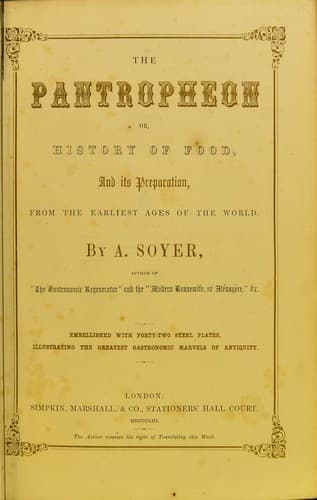
The Pantropheon; Or, History of Food, Its Preparation, from the Earliest Ages of the WorldSoyer, Alexis
History
The Pantropheon; Or, History of Food, Its Preparation, from the Earliest Ages of the World
Soyer, Alexis
Cooking; Food; Gastronomy
Honey served as a basis to the wonderful seasoning of Apicius, which we
present to the studious investigation of modern gastronomy:--Put fifteen
pounds of honey into a brass vessel, containing two pints of wine. Warm
at a very gentle fire, stir, and when it rises, pour over more wine. Let
the mixture rise three times, then take it from the fire, and skim it
the next day. Then add four ounces of ground pepper, three scruples of
gum, a drachm of spikenard, a drachm of saffron, five drachms of dried
dates, after softening them in wine; pour on the whole eighteen pints of
light wine.[XXIII-64]
The _Oxyporon_ was another seasoning much in vogue two thousand years
ago, and in which honey was the principal ingredient. It was composed by
mixing two ounces of cummin seed, one ounce of ginger, one ounce of
green rue, and six scruples of nitre, with one ounce of pepper, and
twelve scruples of fine dates; nine ounces of honey were then poured
over the whole.[XXIII-65]
Sometimes they contented themselves with macerating cummin seed in
vinegar, which they left to dry, and then pounded it; that done, it was
put into honey.[XXIII-66]
“The honey most esteemed is the white, granulated, and of an aromatic
flavour. The honey from the French provinces of Narbonne, the Gatinais,
or Britanny, is the most esteemed. Honey is next of kin to sugar, having
the same properties. It is frequently used in domestic economy, and in
medicine as a laxative. It enters into a number of remedies, either as a
corrective, or an excipient.”--“_Dictio. Encycl._”
SUGAR.
Theophrastus, the first among the ancients who speaks of sugar, classes
it among the number of honeys.[XXIII-67] Dioscorides also calls it
“honey of reeds;” he adds that these reeds grow in India, or in Arabia
Felix, and that the agreeable substance they contain has some analogy
with salt.[XXIII=68] Pliny also gives it the same name. It is, according
to this naturalist, a kind of honey, with which certain reeds are
filled, and used only in medicine.[XXIII-69]
This was also the opinion of many ancient authors;[XXIII-70] one of
whom, Paul Eginetta, calls sugar--Indian salt.[XXIII-71]
The sugar cane appears to be originally a native of the East Indies.
From the most remote ages the Chinese have understood the art of
cultivating it. The histories of the Egyptians, Phœnicians, and Jews,
make no mention of it. The Greek physicians are the first who speak of
it.
It was not till the year 1471 that a Venetian discovered the method of
purifying brown sugar and making loaf sugar. He gained an immense
fortune by this discovery.[XXIII-72]
Sugar cane, well purified, and disburthened of all foreign matter, is
white, solid, inodorous, soluble in water, of a soft and agreeable
savour. Its specific gravity is 1.6065; it is used as a seasoning in a
multitude of dishes, in preparing syrups, preserving of fruits, _&c._,
_&c._
CINNAMON.
Public-domain text, read in full here on John Shaqi.
Reviews
Reviews
No reviews yet
Be the first to share your thoughts on this work.
Elsewhere in the archive
Join the Discussion
Join the discussion
Sign in to leave a comment or review.
Sign InorCreate an account