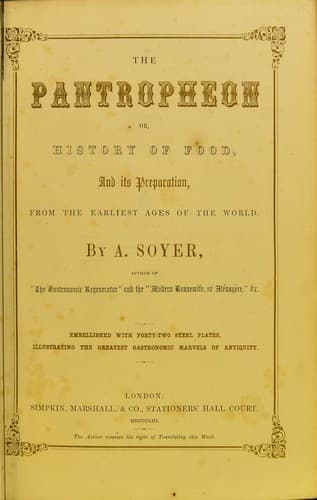
The Pantropheon; Or, History of Food, Its Preparation, from the Earliest Ages of the WorldSoyer, Alexis
History
The Pantropheon; Or, History of Food, Its Preparation, from the Earliest Ages of the World
Soyer, Alexis
Cooking; Food; Gastronomy
In the time of Theophrastus, it was said that cinnamon grew in a dark
and silent valley, guarded night and day by fearful serpents. Animated
by the hope of gain, some individuals, careless of their existence,
risked their lives by gathering some of this precious bark. When they
had the good luck to avoid the vigilant reptiles, they consecrated to
the sun part of their booty, which the radiant orb immediately consumed
to prove his acceptance of the offering.[XXIII-73]
Others, thinking this little tale on the subject of cinnamon rather too
dramatic, pretended that the shrub furnishing it was found only on high
mountains, to which man was forbidden all access. But fortunately
certain birds--the phoenix, among others--great amateurs of aromatics,
make their nests of its small branches; these nests are taken, and in
this manner, whether the year be good or bad, a sufficient stock of
cinnamon is obtained without much trouble.[XXIII-74] Pliny recognises
two kinds of it--one white, the other black, both of which were brought
to Rome from Ethiopia, in the reign of Vespasian.[XXIII-75]
Eighty years after (A.D. 164), Galen informs us that cinnamon was still
very scarce in Italy; that the Emperors alone possessed any; and that
they even preserved it among the curiosities they made it their pleasure
to collect and keep in their palaces.[XXIII-76]
The same writer regards this so precious and uncommon cinnamon as an
excellent cordial and a good digestive.[XXIII-77]
We may add that it was only well known in Europe after the frequent
voyages of the Portuguese to India.[XXIII-78]
However, in 1168, an abbot of St. Gilles, in Languedoc, having a favour
to ask of Louis-le-Jeune, thought there was no better means of
persuading him to grant it than to send him a small stock of
cinnamon.[XXIII-79]
Our forefathers (in the middle ages) had their tables furnished with
cinnamon sauce; nutmeg, mustard, and garlic sauces; cold sauces; parsley
and vinegar sauces, hot sauces, hell sauces, burgher sauces; cherry,
plum, mulberry, grape, gorse, rose, and flower sauces. They were served
with roast meat.
Cinnamon is daily employed in medicine, in diarrhœa, several fevers,
&c., &c., and in pharmacy. That from China is much thicker than the
others, its colour darker, and its odour more powerful; essential oil is
drawn from it, and preserved in flagons, sealed with the arms of
government, and sold at a very high price.
CLOVES.
Cloves were very little known to the ancients. Theophrastus,
Dioscorides, and Galen do not speak of them.
Pliny says that some cloves were brought to Rome, very similar to
grains of pepper but a little longer; that they were only to be found in
India, in a wood consecrated to the gods; and that they served in the
fabrication of perfumes.[XXIII-80]
The conquest of India by the Portuguese rendered them common throughout
Europe.
Public-domain text, read in full here on John Shaqi.
Reviews
Reviews
No reviews yet
Be the first to share your thoughts on this work.
Elsewhere in the archive
Join the Discussion
Join the discussion
Sign in to leave a comment or review.
Sign InorCreate an account