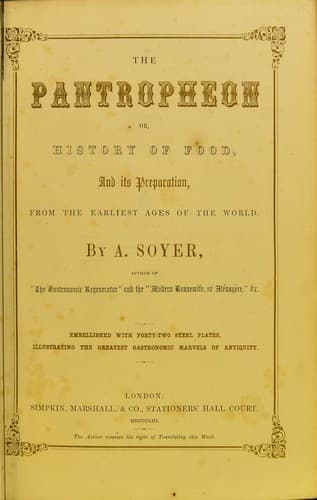
The Pantropheon; Or, History of Food, Its Preparation, from the Earliest Ages of the WorldSoyer, Alexis
History
The Pantropheon; Or, History of Food, Its Preparation, from the Earliest Ages of the World
Soyer, Alexis
Cooking; Food; Gastronomy
Cloves contain a considerable quantity of essential aromatic oil, thick,
brown, and very heavy, to which it owes its aromatic properties and
sharp burning savour. Cloves are employed as a seasoning or as medicine.
PEPPER.
The two great cities of antiquity knew how to appreciate pepper, and
employed it largely in their culinary labours. They distinguished two
kinds: one round, the other long and thin.[XXIII-81]
Dioscorides and Pliny describe the shrub, on which are to be seen pods
filled with seeds of pepper, resembling millet, according to the first
of these writers, and like small beans, according to the
other.[XXIII-82]
Our readers no doubt remember the importance which Apicius ascribes to
pepper, in the learned recipes of that skilful _Archimagirus_.
VERJUICE.
Verjuice, the use of which is very ancient, was used more in
pharmaceutical preparations than in the seasoning of food.[XXIII-83]
Galen attributes to it refreshing qualities, and advises it in certain
cases.[XXIII-84]
Verjuice is a kind of grape, very acid, and which never gets perfectly
ripe. The _suc_ of verjuice is used in medicine and culinary preparation
as an astringent. The juice is not proper to make wine, but a very
agreeable syrup is obtained from it.
VINEGAR.
The greater part of ancient nations were acquainted with the use of
vinegar. Reapers in the east soaked their bread in it, to freshen
it[XXIII-85] The Greeks esteemed that of Cnide, of Sphette, of Cleone,
and above all the vinegar of Egypt,[XXIII-86] which was reputed to be
the best among the Romans, who tempered its acrimony by mixing with it
some sweet substance.[XXIII-87]
These masters of the world did not fancy they possessed all the comforts
of life when they wanted vinegar; therefore they always had a large
provision of it in their cellars, as all their seasonings
proved.[XXIII-88]
This passion (for it certainly amounted to a passion) is easily
explained by the admirable qualities they attributed to the pungent
liquid. It was believed to be astringent, digestive, antibilious,
refreshing, and an antiscorbutic.[XXIII-89] Mixed with water, it was the
drink of the soldiers,[XXIII-90] who, thanks to this beverage, braved
the intemperance of the seasons and the different climates of Europe,
Africa, and Asia.
The Greeks and Romans esteemed highly their pickles: these consisted of
flowers, herbs, roots, and vegetables, preserved in vinegar, and which
kept a long time in cylindrical vases with wide mouths.[XXIII-91] They
were prepared with the greatest care; and these plants were often
macerated in oil, brine, and vinegar, with which they were impregnated
drop by drop.[XXIII-92] Meat, also, cut in very small pieces, was
treated in the same manner.
Public-domain text, read in full here on John Shaqi.
Reviews
Reviews
No reviews yet
Be the first to share your thoughts on this work.
Elsewhere in the archive
Join the Discussion
Join the discussion
Sign in to leave a comment or review.
Sign InorCreate an account