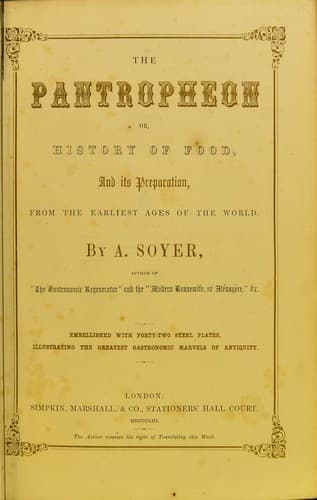
The Pantropheon; Or, History of Food, Its Preparation, from the Earliest Ages of the WorldSoyer, Alexis
History
The Pantropheon; Or, History of Food, Its Preparation, from the Earliest Ages of the World
Soyer, Alexis
Cooking; Food; Gastronomy
Vinegar of an exorbitant price was obtained from some precious wines,
and that price was again increased by the proverbial cupidity of some
butlers in great houses. We doubt much, however, whether any of those
worthy personages ever made such a bill as a certain French seigneur
dared to do under the reign of Louis XIII. It is said that the Duc de la
Meilleraye, grand master of the artillery of France, presented to the
minister a bill in which figured an article of 1,300,000 francs
(£52,000), for vinegar to cool the cannons! The sum appeared rather
large, but La Meilleraye was a near relation of Richelieu, and the
article passed without the least contestation.[XXIII-93]
TRUFFLE.
A truffled turkey was to be eaten at a dinner where Buffon was invited.
A few minutes before setting down to table, an elderly lady inquired of
the celebrated naturalist where the truffle grew. “At your feet,
madame.” The lady did not understand; but it was thus explained to her:
“_C’est au pied des charmes_” (yoke elm tree). The compliment appeared
to her most flattering. Towards the end of the dinner, some one asked
the same question of the illustrious writer, who, forgetting that the
lady was beside him, innocently replied: “They grow _aux pieds des vieux
charmes_” (old yoke elm trees). The lady overheard him, and no longer
thought anything of his amiability.
Nevertheless Buffon was right. It was around the yoke elm trees of
Lampsachus, Acarnidea, Alopecomesia, and Elis, that those famous
truffles were discovered, whose reputation was spread in all parts and
which Italy envied Greece.[XXIII-94]
The truffle! beloved treasure that the earth conceals within her
bosom--as she does the precious metals, which she seems to have yielded
grudgingly to the patient researches of the gastronomist; the magiric
records do not tell us at what memorable epoch this exquisite tubercle
astonished, for the first time, the palate of man; but a doubtful
tradition maintains that a vile animal (a pig), guided by his marvellous
gluttony, found out the existence of this pearl of banquets.
Pliny was very much inclined to range the truffles amidst astonishing
prodigies. He fancied that he saw it at its birth increase without
roots, without the slightest fibre, without the least capillary vessel
likely to transmit to it nutritious juices;[XXIII-95] therefore he
believed that, sown by thunder-bolts in the autumnal storms,[XXIII-96]
this daughter of thunder grew like minerals by juxta-position, and
relates on this subject the history of Lartius Licinius, governor of
Spain, who, while biting a truffle with avidity, broke one of his teeth
against a Roman denarius which chance alone had inclosed within
it.[XXIII-97]
Public-domain text, read in full here on John Shaqi.
Reviews
Reviews
No reviews yet
Be the first to share your thoughts on this work.
Elsewhere in the archive
Join the Discussion
Join the discussion
Sign in to leave a comment or review.
Sign InorCreate an account