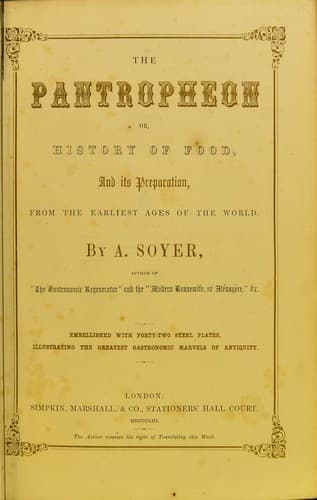
The Pantropheon; Or, History of Food, Its Preparation, from the Earliest Ages of the WorldSoyer, Alexis
History
The Pantropheon; Or, History of Food, Its Preparation, from the Earliest Ages of the World
Soyer, Alexis
Cooking; Food; Gastronomy
The Greeks thought a great deal of a delicious species of truffles,
smooth outside, red within, which were found just under the surface of
the ground, and did not show the slightest appearance of
vegetation.[XXIII-98] Another kind was also much sought after by
amateurs, probably on account of their scarcity. They were originally
from Africa, and called cyrenaïc, white outside, of an excellent
perfume, and exquisite flavour.[XXIII-99]
The Athenians, enlightened appreciates of all sorts of merits, accepted
with gratitude a _ragoût_ with truffles, invented by Cherips. That
culinary genius did not long enjoy his glory; a premature death carried
him off from his stoves, his honours, and his fortune; but the Greeks
did not bury their gratitude in his tomb; his sons became citizens of
Athens, and the name of their father, more fortunate than that of
Christopher Columbus, clung for ever to his brilliant
discovery.[XXIII-100]
The doctors of other days did not exactly agree upon the quality either
good or bad of truffles. Philoxenes, whose opinion met with many
partisans, would have it that a great quantity should be eaten cooked
under the ashes, and deliciously impregnated with a succulent
sauce.[XXIII-101] It was, however, recommended to choose them with the
most particular attention, because some had the reputation of being as
poisonous as mushrooms.[XXIII-102]
The Romans were as fond of truffles as the Greeks, and that is not
saying little.[XXIII-103] Apicius gives a method of preparing them which
is as follows:--
After they are boiled in water, put a little stick through them, and
then place them for an instant before the fire; season them afterwards
with oil, a little meat gravy, some skirrets, wine, pepper, and honey,
in proper proportions. When the sauce is boiling, make a thickening, and
serve.[XXIII-104]
The illustrious epicurean prepared them also with pepper, benzoin,
coriander and rue, to which he added a little honey, oil, and
gravy.[XXIII-105]
The estimable Platina insists that, in the first place, truffles should
be washed in wine, and afterwards cooked under the ashes; and that they
be served hot, and sprinkled over with salt and pepper.[XXIII-106]
This is the composition of a syrup of truffles, taken from the old
Arabian medicine. We believe it to be very little known, and should not
be surprised if it were, some day, to obtain the renown it seems to
deserve. It was composed of truffles, balm, and holy thistle, boiled in
water with sugar; and to each pound of the decoction was added one
scruple of water distilled from honey, and half an ounce of some
spirit--say, for example, spirits of wine--to each pound of liquor. The
whole was aromatised with musk and a little rose-water. Two ounces of
this syrup were administered hot,[XXIII-107] in cases of weakness.
Public-domain text, read in full here on John Shaqi.
Reviews
Reviews
No reviews yet
Be the first to share your thoughts on this work.
Elsewhere in the archive
Join the Discussion
Join the discussion
Sign in to leave a comment or review.
Sign InorCreate an account