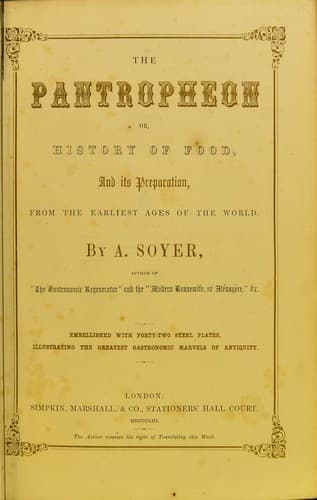
The Pantropheon; Or, History of Food, Its Preparation, from the Earliest Ages of the WorldSoyer, Alexis
History
The Pantropheon; Or, History of Food, Its Preparation, from the Earliest Ages of the World
Soyer, Alexis
Cooking; Food; Gastronomy
Salmasius, who knew much of the Greek tongue, and very little of
cookery, avers that the ancients knew two different kinds of truffles.
One species was similar to ours, and the other a variety from Africa,
already mentioned, white outside and the size of a quince.[XXIII-108]
Leo the African, says that the Arabs cook these truffles in milk, and
that they think them exquisite. Thereupon Salmasius exclaims against the
insipidity of this dish, or the ignorance of Leo the African; and
immediately points out, with an air of triumph, the celebrated Avicenna,
who informs us that, after the truffles were peeled and cut in small
pieces, they were cooked in water and salt, and then dished up with oil,
benzoin, and spices. Salmasius will have it that Avicenna’s truffles had
no other flavour than that given by the sauce, and he has no forgiveness
for those poor Arabs who dared to dress them otherwise.
If this clever Hellenist had studied this savoury tubercle with as much
care as he bestowed on the writers of the history of Augustus, he would
have learned that the peculiar perfume which distinguishes it retains,
in the midst of seasoning the most laboriously prepared, the same power
it possesses when eaten by itself, and without any dressing.
Apicius had less of literature than Salmasius, but he was most assuredly
gifted in a very superior degree with that _mens divinior_ which makes
great cooks and illustrious poets. This assimilation has nothing
surprising in it, if we only remember that genius is nothing else than
the faculty of producing; and who ever bequeathed to posterity
productions more exquisite than those of Archestrates and Apicius?
Let us hear from this latter how to preserve truffles. You must be
careful not to put them in contact with water; that is to say, that they
ought to be kept very dry. They are placed separately in vessels, and
covered with iron filings, or saw-dust. Close each vessel hermetically
with plaster, and keep them in a dark and cool place.[XXIII-109]
The truffle is a very remarkable vegetable, which, without stems, roots,
or fibres, grows of itself, isolated in the bosom of the earth,
absorbing the nutritive juice. Its form is round, more or less regular;
its surface is smooth or tuberculous; the colour dark-brown outside,
brown, grey, or white within. Its tissue is formed of articulated
filaments, between which are spheric vesicles, and in the interior are
placed reproductive bodies, small brown spheres, called _truffinelles_.
Truffles vegetate to the depth of five or six inches in the high sandy
soils of the south-west of France, of Piedmont, &c., &c. Their mode of
vegetation and reproduction is not known. Dogs are trained to find them,
as well as pigs, and boars also, who are very fond of them. They are
eaten cooked under the ashes, or in wine and water. They are preserved,
when prepared in oil, which is soon impregnated with their odour.
Public-domain text, read in full here on John Shaqi.
Reviews
Reviews
No reviews yet
Be the first to share your thoughts on this work.
Elsewhere in the archive
Join the Discussion
Join the discussion
Sign in to leave a comment or review.
Sign InorCreate an account