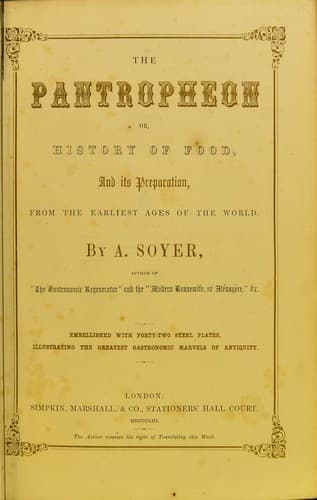
The Pantropheon; Or, History of Food, Its Preparation, from the Earliest Ages of the WorldSoyer, Alexis
History
The Pantropheon; Or, History of Food, Its Preparation, from the Earliest Ages of the World
Soyer, Alexis
Cooking; Food; Gastronomy
However, reasonable people--and there were still some to be
found--abstained entirely from this vegetable, or procured it by the
method which Nicander recommends; that is to say, they frequently
watered the trunk of a fig tree after manure had been placed around it.
That philosopher assures us that by these means we may grow mushrooms
perfectly wholesome.[XXIII-121]
Those of our readers who are in possession of fig trees will be able to
give their opinion on the merit of Nicander’s method.
To obtain the seeds of most mushrooms, it only requires to expose them,
when fresh, upon glass; the superficies of the glass is soon covered
with it. It is also obtained by shaking in the water the mushrooms which
are sufficiently developed. This water, thus impregnated, is used to
water the beds, which become thereby more productive.
The natural supply of mushrooms from the fields not being thought
sufficient, the art of raising them on beds during the whole year was
therefore indispensable, and required a mixture of _crottin de cheval_,
rotten dung, and mould, which is deposited in layers of one foot and
a-half in thickness and width. Seeds of mushrooms are sown on these
beds--that is to say, some of the mould of a former bog impregnated with
it. It is then covered over with all the dung not consumed, and then
copiously watered.
“At the end of a very few days, the beds begin to produce mushrooms, and
keep on producing until the winter.”--BOSC.
XXIV.
PASTRY.
The art of the pastry-cook consists in preparing certain delicate and
nice pastes in all sorts of shapes, in seasoning them with discretion,
and in sufficient quantity, with meat, butter, sugar, preserves,
&c.[XXIV-1] It is a most important branch of the culinary science;
unceasingly occupied with flattering the sight as much as the taste, it
raises graceful monuments, delicious fortresses, seductive ramparts,
which as soon as they are on all sides attacked, totter, crumble, and no
longer present anything but glorious and ephemeral ruins, like every
other work of man--all pass away whether they be temples, columns,
pyramids, or pies.
This charming art was known to ancient nations as soon as their
intellectual development had enabled them to understand a certain
gastronomic truth, long since become a trivial axiom, and of which we
dare scarcely remind the reader: “_On ne mange pour vivre que lorsqu’on
ne sait pas vivre pour manger._” (People only eat to live when they do
not understand how to live to eat.)
The oriental nations were acquainted with the art of making pastry at a
very early period. The Egyptians served many different sorts of cakes at
their tables;[XXIV-2] the Jews knew of at least three kinds--one sort
kneaded with oil, another fried in oil, and the last was merely rubbed
over with oil.[XXIV-3]
Public-domain text, read in full here on John Shaqi.
Reviews
Reviews
No reviews yet
Be the first to share your thoughts on this work.
Elsewhere in the archive
Join the Discussion
Join the discussion
Sign in to leave a comment or review.
Sign InorCreate an account