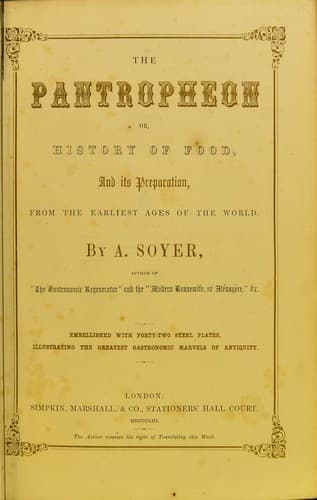
The Pantropheon; Or, History of Food, Its Preparation, from the Earliest Ages of the WorldSoyer, Alexis
History
The Pantropheon; Or, History of Food, Its Preparation, from the Earliest Ages of the World
Soyer, Alexis
Cooking; Food; Gastronomy
The enlightened gluttony of the Greeks and Romans inspired them with a
host of combinations more or less ingenious, and destined to revive a
failing appetite, or one already greatly compromised by vigorous
onslaughts.
Some of these pastries would appear very nice to us in the present day;
others we should think but little worthy of the epicures of Rome and
Athens. However, let us not be in too great a hurry to condemn these
great masters. Doubtless they had excellent reasons to like that which
modern taste may despise and dislike. In return, they might have thought
some of our most fashionable dishes detestable; perhaps Apicius might
have made a strange grimace at the sight of a dish of sour-crout, an
olla-podrida, or an immense plum-pudding.
_Oublies_, a light dainty for those who have weak stomachs, were thin
sheets of paste composed of flour and honey, which rolled into a spiral
form as soon as they approached the oven. They were eaten soaked in
cooked wine.[XXIV-4] Persons of taste preferred _oublies_ to fritters--a
bold mixture of flour kneaded with wine, seasoned with pepper, and then
worked up with milk, and, finally, with a little fat or oil.[XXIV-5]
Some cooks employed the finest flour only, mixed with oil, and served
this paste after having cooked it in a dish.[XXIV-6] Others worked
sesame flour a long time with honey and oil, and fried it.[XXIV-7] These
various kinds of fritters were, doubtless, much sought after by the
populace, for Cicero speaks of them with profound disdain.[XXIV-8]
The Jews, less dainty than the eloquent orator, offered some of this
paste in sacrifice. The recipe for its composition is given in
Leviticus; it was made of the finest flour, moistened with oil, and
cooked in the frying-pan.[XXIV-9]
Women and children--those two fragile roots of society--were always fond
of sweet and delicate cakes. The pastry-cooks of Attica prepared for
them some very excellent kinds; sometimes it was merely a sweet mixture
of honey and milk;[XXIV-10] others were made of honey, sesame flour, and
cheese or oil.[XXIV-11] Delicious fruit was frequently covered with a
light and perfumed paste.[XXIV-12] These Athenian dumplings met with a
great success.
Rome made the conquest of these precious recipes,[XXIV-13] and
vanquished Greece, conquered by her, had still the glory of dictating
laws to her haughty enemy: she imposed her cookery.
Gingerbread was not unknown to the ancients. Rhodes owed its reputation
to it. It was sweetened with honey, and that island furnished it to the
whole of Europe. The Greeks called this delicacy _Melitates_, and eat it
with pleasure at the close of their repasts.[XXIV-14]
Let us not forget, in this rapid survey of ancient sweets, that learned
and exquisite mixture now designated under the name of _Nougat_, which,
among the Greeks was composed of dried currants and almonds, and which
has lost none of its attractions, nothing of its celebrity, after so
many centuries.[XXIV-15]
Public-domain text, read in full here on John Shaqi.
Reviews
Reviews
No reviews yet
Be the first to share your thoughts on this work.
Elsewhere in the archive
Join the Discussion
Join the discussion
Sign in to leave a comment or review.
Sign InorCreate an account