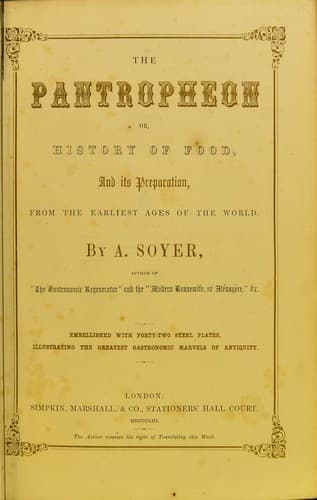
The Pantropheon; Or, History of Food, Its Preparation, from the Earliest Ages of the WorldSoyer, Alexis
History
The Pantropheon; Or, History of Food, Its Preparation, from the Earliest Ages of the World
Soyer, Alexis
Cooking; Food; Gastronomy
Titus Livy said, in speaking of Rome, “The greatest things have small
beginnings.” This applies equally to pastry, which appears so unworthy
of attention at the commencement of the middle ages that nothing seems
to announce its high destiny. At first, in the southern provinces,
people simply mixed flour, oil, and honey. The Roman school was still in
force. The inhabitants of the north had a mind to innovate; they
employed eggs, butter, and salt. Then came the idea of inclosing within
this paste cooked meat, seasoned with bacon and spices; and, from
progress to progress, they at last inclosed cream, fruit, and
marmalades.[XXIV-38]
We find pastry mentioned for the first time in a charter of
Louis-le-Débonnaire (802). It is there said that a certain farm of the
Abbey of St. Denis is to furnish, at certain festivals, sixteen measures
of honey, eleven hundred oxen, and five hogsheads of flour to make
pastry.[XXIV-39]
A charter of the church of Paris, 1202, mentions simnels or wigs, under
the name of “_panes leves qui dicuntur echaudati_.” Joinville speaks, in
“The life of St. Louis,” of cheese fritters cooked in the sun, which the
Saracens presented to that king and his knights when they restored them
to liberty. And, finally, so early as the 13th century, the _flans_ of
Chartres, the patties of Paris, and the tarts of Dourlans, were in great
renown; and a charter of 1301 informs us that, at that epoch, several
lords imposed on their vassals a tribute of _fugués_, or
puff-pastry.[XXIV-40]
The cook of Charles V. says, that the word _tourte_ signified a
household loaf of a round form; that this name was afterwards given to
delicate pastry; and that, by corruption, it was called _tart_ in
certain provinces.[XXIV-41]
Taillevant speaks of cream, almonds, and rose-water, as the
accompaniments of _Darioles_, a kind of custard; and of _Talmouses_, a
sort of cheese-cake, made of cheese, eggs, and butter, coloured with the
yolks of eggs.[XXIV-42]
Platina cites tarts made with radishes, quinces, gourds, elder-berry
flowers, rice, oatmeal, millet, chesnuts, cherries, dates, May-herbs,
roses, and, lastly, the white, or cream tart.[XXIV-43]
XXV.
WATER.
Thales, who borrowed from Egypt the elements of philosophy, which he
afterwards spread in Greece, taught that water is the vivifying
principle of all things; that nature is thereby made fruitful; that
without it the earth, arid and laid waste, would be a frightful desert,
where every effort of man to support his existence must fail.[XXV-1]
These ideas, for a long time adopted by Pagan theology, peopled
fountains, rivers, and seas, with divinities, and often confounded in
the same worship those gods, sons of gratitude, with the limpid waters
consecrated to them.
The Persians carried their veneration for this element so far, that they
dared not wash their hands, and would have preferred being consumed to
the very bone rather than dip themselves in a river.[XXV-2]
Public-domain text, read in full here on John Shaqi.
Reviews
Reviews
No reviews yet
Be the first to share your thoughts on this work.
Elsewhere in the archive
Join the Discussion
Join the discussion
Sign in to leave a comment or review.
Sign InorCreate an account