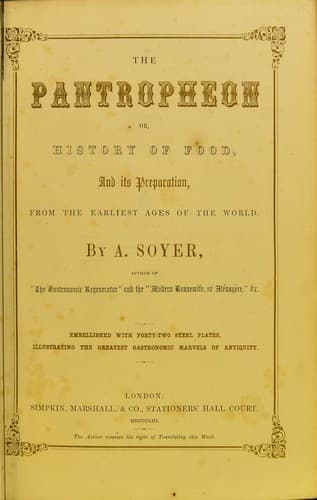
The Pantropheon; Or, History of Food, Its Preparation, from the Earliest Ages of the WorldSoyer, Alexis
History
The Pantropheon; Or, History of Food, Its Preparation, from the Earliest Ages of the World
Soyer, Alexis
Cooking; Food; Gastronomy
This vase, made of one single piece of crystal, is in its original
size; the delicacy of the work gives a great value to it. The body
of the vase, and all other parts in relief, are of glass. It was
discovered in 1725, and is preserved in the cabinet of the Marquis
of Trivulsi, at Milan. The fillet round the body, and those forming
the ordinary motto of the feasts--“BIBE VIVAS MULTIS ANNIS”--are
isolated from the body of the cup about one quarter of an inch, and
are attached to it by threads or fillets of glass, very fine. They
are not soldered to the cup, but the whole of the labour is worked
on a turning lathe, being seen more or less angular as the
instrument may have been led to penetrate in the most difficult
parts. The inscription is green; the fillet is blue: these two
colours are very bright. The cup is an opaque or changing colour,
without being able to distinguish whether that hue was intended to
be so, as it happens to glass which has remained a long while
buried, exposed to the vapours of a dunghill, or a sewer, &c., &c.
A second antique vase is known to exist, whose workmanship is
similar.--“_Histoire de l’Art_,” Liv. I., Chap. I., page
45.--Paris: Janson.
and Nero spent the like sum for a vase with two handles, which he forgot
two days afterwards.[XXVII-32]
The Murrhine cups appeared on the table with the wine of the “hundred
leaves,” and the Falernian was poured into them, so as to preserve all
the generous delicacy of its odour.[XXVII-33]
The Murrhines were much sought after, on account of their form and
brilliant transparency: they were made of mother of pearl, according to
Belon, but others say of agate. Their dimensions, however, would incline
one to doubt it. Scaliger,[XXVII-34] Cardan,[XXVII-35] and Madame
Dacier,[XXVII-36] thought that the ancients gave unheard-of prices for
simple porcelain vases, which were precious on account of their rarity.
This opinion, which several modern _literati_[XXVII-37] have adopted,
rests plausibly enough, it appears, on one verse of Propertius, in which
this poet speaks of “Murrhine cups, baked in the furnace of the
Parthians.”[XXVII-38] It has been said that, perhaps the Parthians
learnt from the Chinese how to make porcelain; but this supposition,
entirely void of proof, has been contradicted in a most peremptory
manner by the author of a very curious book, who demonstrates
irrefragably that the Murrhines were not of porcelain, but of stones of
the species of onyx.[XXVII-39] The following fact will leave but very
little doubt on that subject:--
Public-domain text, read in full here on John Shaqi.
Reviews
Reviews
No reviews yet
Be the first to share your thoughts on this work.
Elsewhere in the archive
Join the Discussion
Join the discussion
Sign in to leave a comment or review.
Sign InorCreate an account