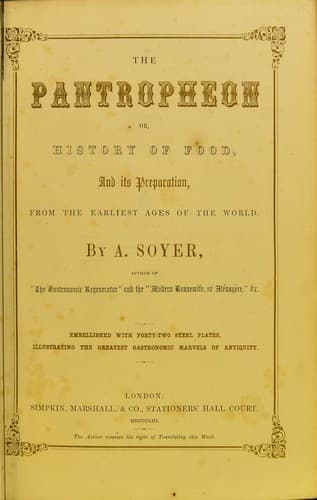
The Pantropheon; Or, History of Food, Its Preparation, from the Earliest Ages of the WorldSoyer, Alexis
History
The Pantropheon; Or, History of Food, Its Preparation, from the Earliest Ages of the World
Soyer, Alexis
Cooking; Food; Gastronomy
In 1791, the Constituent National Assembly, appointed a commission to
make an inventory and valuation of all objects in the Garde-Meuble of
the crown. They found, among other very beautiful sardonyx, two very
antique vases: one made in the form of an ewer, ten inches in height and
four inches in diameter, having its handle cut out of the same piece,
and the second, hollowed out as a bowl, ten inches in diameter, which
were recognised as real Murrhines--beautiful white and blue veins and
other shades, circulated about the bowl without interfering with its
semi-transparency; the bottom was of the same colour as the ewer. The
jewellers estimated these vases at £6,000 each, although there was
nothing engraved in the hollow nor in relief, but merely on
consideration of the beauty of the material, the fineness of the polish,
and the difficulty that must have attended the hollowing out of the
ewer.[XXVII-40]
These valuations would appear exaggerated, if it were not known that the
antique vase of the Duke of Brunswick, which formerly belonged to the
Dukes of Mantua, in 1631, and made of sardonyx, in the cruet shape, was
valued at 150,000 German crowns--or dollars of 4_s._ 3_d._ The relief
[Illustration: _Pl. 21_
MURRHIN CUP.]
engraving represented the mysteries of Ceres and Bacchus; but it had no
primitive handle, and the diameter was only two inches and
a-half.[XXVII-41]
By the side of these inestimable Murrhines were standing very graceful
chalices of amber, the prodigious workmanship of which absolutely gave
to them a most arbitrary value,[XXVII-42] but which Roman prodigality
never found too high.
Silver cups engraved were also nearly as much esteemed, when they came
from the hands of some well-known workman--such as Myos, Mentor, or
Myron.[XXVII-43] They were even preferred to gold cups,[XXVII-44] unless
these latter were enriched with precious stones.[XXVII-45]
All these vases presented still greater varieties in their forms than in
the materials employed. There were very large ones, some narrow, some
oblong; many ornamented with two handles, others had only one.[XXVII-46]
Some were much like a tympanon--or zoph, a musical instrument of the
ancient Hebrews--a small boat or ewer.[XXVII-47] In one word, the Greek
or Roman artist never listened to anything but his own fancy, and was
then far from supposing that he was preparing very long and wakeful
hours of study to many antiquarians, zealous to explain seriously the
strange wanderings of a fantastical imagination.
DESCRIPTION OF PLATE No. XXI.
Public-domain text, read in full here on John Shaqi.
Reviews
Reviews
No reviews yet
Be the first to share your thoughts on this work.
Elsewhere in the archive
Join the Discussion
Join the discussion
Sign in to leave a comment or review.
Sign InorCreate an account