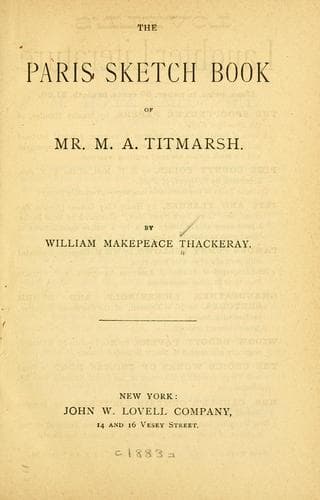
The Paris Sketch Book of Mr. M. A. TitmarshThackeray, William Makepeace
General
The Paris Sketch Book of Mr. M. A. Titmarsh
Thackeray, William Makepeace
Paris (France) -- Description and travel
and that vigorous unity, which Lutheranism wanted. The latter had,
indeed, in its favor, the liberty of inquiry, which is also a want of
the human mind; and had proclaimed the authority of individual reason:
but it had so lost that which is the necessary basis and vital
condition of all revealed religion—the principle of infallibility;
because nothing can live except in virtue of the laws that presided at
its birth; and, in consequence, one revelation cannot be continued and
confirmed without another. Now, infallibility is nothing but revelation
continued by God, or the Word, in the person of his vicars.
“At last, after much reflection, Hebronius acknowledged himself
entirely and sincerely convinced, and received baptism from the hands
of Bossuet. He added the name of Spiridion to that of Peter, to signify
that he had been twice enlightened by the Spirit. Resolved
thenceforward to consecrate his life to the worship of the new God who
had called him to Him, and to the study of His doctrines, he passed
into Italy, and, with the aid of a large fortune, which one of his
uncles, a Catholic like himself, had left to him, he built this convent
where we now are.”
A friend of mine, who has just come from Italy, says that he has there
left Messrs. Sp—r, P—l, and W. Dr—d, who were the lights of the great
church in Newman Street, who were themselves apostles, and declared and
believed that every word of nonsense which fell from their lips was a
direct spiritual intervention. These gentlemen have become Puseyites
already, and are, my friend states, in the high way to Catholicism.
Madame Sand herself was a Catholic some time since: having been
converted to that faith along with M. N—, of the Academy of Music; Mr.
L—, the pianoforte player; and one or two other chosen individuals, by
the famous Abbé de la M—. Abbé de la M— (so told me in the Diligence, a
priest, who read his breviary and gossiped alternately very curiously
and pleasantly) is himself an âme perdue: the man spoke of his brother
clergyman with actual horror; and it certainly appears that the Abbé’s
works of conversion have not prospered; for Madame Sand, having brought
her hero (and herself, as we may presume) to the point of Catholicism,
proceeds directly to dispose of that as she has done of Judaism and
Protestantism, and will not leave, of the whole fabric of Christianity,
a single stone standing.
Public-domain text, read in full here on John Shaqi.
Reviews
Reviews
No reviews yet
Be the first to share your thoughts on this work.
Elsewhere in the archive
Join the Discussion
Join the discussion
Sign in to leave a comment or review.
Sign InorCreate an account