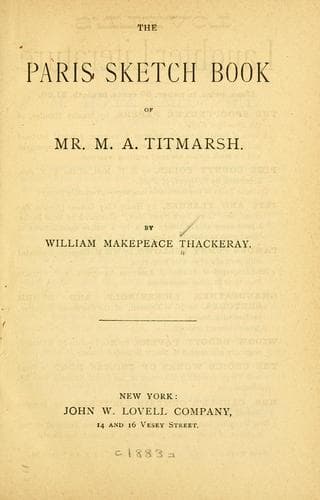
The Paris Sketch Book of Mr. M. A. TitmarshThackeray, William Makepeace
General
The Paris Sketch Book of Mr. M. A. Titmarsh
Thackeray, William Makepeace
Paris (France) -- Description and travel
“What other than Sebastian Peytel could have committed this
murder?—whom could it profit?—who but himself had an odious chain to
break, and an inheritance to receive? Why speak of the servant’s
projected robbery? The pistols found by the side of Louis’s body, the
balls bought by him at Macon, and those discovered at Belley among his
effects, were only the result of a perfidious combination. The pistol,
indeed, which was found on the hill of Darde, on the night of the 1st
of November, could only have belonged to Peytel, and must have been
thrown by him, near the body of his domestic, with the paper which had
before enveloped it. Who had seen this pistol in the hands of Louis?
Among all the gendarmes, work-women, domestics, employed by Peytel and
his brother-in-law, is there one single witness who had seen this
weapon in Louis’s possession? It is true that Madame Peytel did, on one
occasion, speak to M. de Montrichard of a pistol; which had nothing to
do, however, with that found near Louis Rey.”
Is this justice, or good reason? Just reverse the argument, and apply
it to Rey. “Who but Rey could have committed this murder?—who but Rey
had a large sum of money to seize upon?—a pistol is found by his side,
balls and powder in his pocket, other balls in his trunks at home. The
pistol found near his body could not, indeed, have belonged to Peytel:
did any man ever see it in his possession? The very gunsmith who sold
it, and who knew Peytel, would he not have known that he had sold him
this pistol? At his own house, Peytel has a collection of weapons of
all kinds; everybody has seen them—a man who makes such collections is
anxious to display them. Did any one ever see this weapon?—Not one. And
Madame Peytel did, in her lifetime, remark a pistol in the valet’s
possession. She was short-sighted, and could not particularize what
kind of pistol it was; but she spoke of it to her husband and her
brother-in-law.” This is not satisfactory, if you please; but, at
least, it is as satisfactory as the other set of suppositions. It is
the very chain of argument which would have been brought against Louis
Rey by this very same compiler of the act of accusation, had Rey
survived, instead of Peytel, and had he, as most undoubtedly would have
been the case, been tried for the murder.
This argument was shortly put by Peytel’s counsel:—“if Peytel had been
killed by Rey in the struggle, would you not have found Rey guilty of
the murder of his master and mistress?” It is such a dreadful dilemma,
that I wonder how judges and lawyers could have dared to persecute
Peytel in the manner which they did.
After the act of accusation, which lays down all the suppositions
against Peytel as facts, which will not admit the truth of one of the
prisoner’s allegations in his own defence, comes the trial. The judge
is quite as impartial as the preparer of the indictment, as will be
seen by the following specimens of his interrogatories:—
Public-domain text, read in full here on John Shaqi.
Reviews
Reviews
No reviews yet
Be the first to share your thoughts on this work.
Elsewhere in the archive
Join the Discussion
Join the discussion
Sign in to leave a comment or review.
Sign InorCreate an account