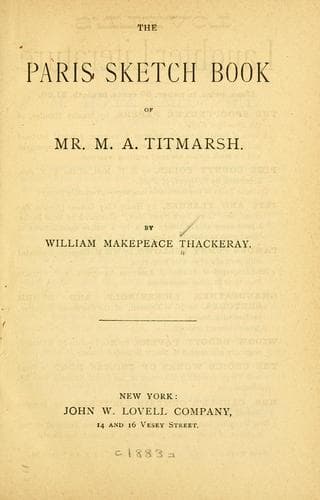
The Paris Sketch Book of Mr. M. A. TitmarshThackeray, William Makepeace
General
The Paris Sketch Book of Mr. M. A. Titmarsh
Thackeray, William Makepeace
Paris (France) -- Description and travel
Judge. “The act of accusation finds in your statement contradictions,
improbabilities, impossibilities. Thus your domestic, who had
determined to assassinate you, in order to rob you, and who MUST HAVE
CALCULATED UPON THE CONSEQUENCE OF A FAILURE, had neither passport nor
money upon him. This is very unlikely; because he could not have gone
far with only a single halfpenny, which was all he had.”
Prisoner. “My servant was known, and often passed the frontier without
a passport.”
Judge. “YOUR DOMESTIC HAD TO ASSASSINATE TWO PERSONS, and had no weapon
but a single pistol. He had no dagger; and the only thing found on him
was a knife.”
Prisoner. “In the car there were several turner’s implements, which he
might have used.”
Judge. “But he had not those arms upon him, because you pursued him
immediately. He had, according to you, only this old pistol.”
Prisoner. “I have nothing to say.”
Judge. “Your domestic, instead of flying into woods, which skirt the
road, ran straight forward on the road itself: THIS, AGAIN, IS VERY
UNLIKELY.”
Prisoner. “This is a conjecture I could answer by another conjecture; I
can only reason on the facts.”
Judge. “How far did you pursue him?”
Prisoner. “I don’t know exactly.”
Judge. “You said ‘two hundred paces.’”
No answer from the prisoner.
Judge. “Your domestic was young, active, robust, and tall. He was ahead
of you. You were in a carriage, from which you had to descend: you had
to take your pistols from a cushion, and THEN your hammer;—how are we
to believe that you could have caught him, if he ran? It is
IMPOSSIBLE.”
Prisoner. “I can’t explain it: I think that Rey had some defect in one
leg. I, for my part, run tolerably fast.”
Judge. “At what distance from him did you fire your first shot?”
Prisoner. “I can’t tell.”
Judge. “Perhaps he was not running when you fired.”
Prisoner. “I saw him running.”
Judge. “In what position was your wife?”
Prisoner. “She was leaning on my left arm, and the man was on the right
side of the carriage.”
Judge. “The shot must have been fired à bout portant, because it burned
the eyebrows and lashes entirely. The assassin must have passed his
pistol across your breast.”
Prisoner. “The shot was not fired so close; I am convinced of it:
professional gentlemen will prove it.”
Judge. “That is what you pretend, because you understand perfectly the
consequences of admitting the fact. Your wife was hit with two
balls—one striking downwards, to the right, by the nose, the other
going horizontally through the cheek, to the left.”
Prisoner. “The contrary will be shown by the witnesses called for the
purpose.”
Judge. “IT IS A VERY UNLUCKY COMBINATION FOR YOU that these balls,
which went, you say, from the same pistol, should have taken two
different directions.”
Prisoner. “I can’t dispute about the various combinations of
fire-arms—professional persons will be heard.”
Judge. “According to your statement, your wife said to you, ‘My poor
husband, take your pistols.’”
Public-domain text, read in full here on John Shaqi.
Reviews
Reviews
No reviews yet
Be the first to share your thoughts on this work.
Elsewhere in the archive
Join the Discussion
Join the discussion
Sign in to leave a comment or review.
Sign InorCreate an account