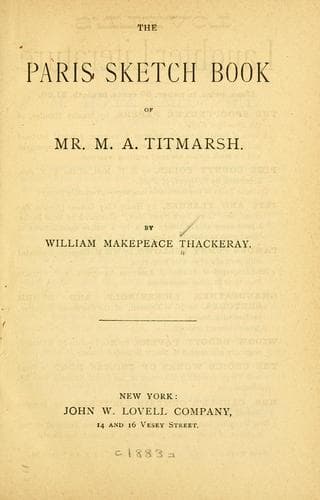
The Paris Sketch Book of Mr. M. A. TitmarshThackeray, William Makepeace
General
The Paris Sketch Book of Mr. M. A. Titmarsh
Thackeray, William Makepeace
Paris (France) -- Description and travel
Prisoner. “She did.”
Judge. “In a manner quite distinct.”
Prisoner. “Yes.”
Judge. “So distinct that you did not fancy she was hit?”
Prisoner. “Yes; that is the fact.”
Judge. “HERE, AGAIN, IS AN IMPOSSIBILITY; and nothing is more precise
than the declaration of the medical men. They affirm that your wife
could not have spoken—their report is unanimous.”
Prisoner. “I can only oppose to it quite contrary opinions from
professional men, also: you must hear them.”
Judge. “What did your wife do next?”
Judge. “You deny the statements of the witnesses:” (they related to
Peytel’s demeanor and behavior, which the judge wishes to show were
very unusual;—and what if they were?) “Here, however, are some mute
witnesses, whose testimony, you will not perhaps refuse. Near Louis
Rey’s body was found a horse-cloth, a pistol, and a whip..... Your
domestic must have had this cloth upon him when he went to assassinate
you: it was wet and heavy. An assassin disencumbers himself of anything
that is likely to impede him, especially when he is going to struggle
with a man as young as himself.”
Prisoner. “My servant had, I believe, this covering on his body; it
might be useful to him to keep the priming of his pistol dry.”
The president caused the cloth to be opened, and showed that there was
no hook, or tie, by which it could be held together; and that Rey must
have held it with one hand, and, in the other, his whip, and the pistol
with which he intended to commit the crime; which was impossible.
Prisoner. “These are only conjectures.”
And what conjectures, my God! upon which to take away the life of a
man. Jeffreys, or Fouquier Tinville, could scarcely have dared to make
such. Such prejudice, such bitter persecution, such priming of the
jury, such monstrous assumptions and unreason—fancy them coming from an
impartial judge! The man is worse than the public accuser.
“Rey,” says the Judge, “could not have committed the murder, BECAUSE HE
HAD NO MONEY IN HIS POCKET, TO FLY, IN CASE OF FAILURE.” And what is
the precise sum that his lordship thinks necessary for a gentleman to
have, before he makes such an attempt? Are the men who murder for
money, usually in possession of a certain independence before they
begin? How much money was Rey, a servant, who loved wine and women, had
been stopping at a score of inns on the road, and had, probably, an
annual income of 400 francs,—how much money was Rey likely to have?
“Your servant had to assassinate two persons.” This I have mentioned
before. Why had he to assassinate two persons,[*] when one was enough?
If he had killed Peytel, could he not have seized and gagged his wife
immediately?
* M. Balzac’s theory of the case is, that Rey had intrigued with Madame
Peytel; having known her previous to her marriage, when she was staying
in the house of her brother- in-law, Monsieur de Montrichard, where Rey
had been a servant.
Public-domain text, read in full here on John Shaqi.
Reviews
Reviews
No reviews yet
Be the first to share your thoughts on this work.
Elsewhere in the archive
Join the Discussion
Join the discussion
Sign in to leave a comment or review.
Sign InorCreate an account